东北大学学报(社会科学版) ›› 2026, Vol. 28 ›› Issue (2): 85-95.DOI: 10.15936/j.cnki.1008-3758.2026.02.009

• 政治与公共管理 • 上一篇    下一篇

城市社区议事协商实践及其运行机制探究

孙蕊1,2, 张雅茹1,3   

  1. 1.中国政法大学 政治与公共管理学院,北京 100088
    2.清华大学 战略新兴产业研究中心,北京 100084
    3.山西农业大学 公共管理学院,山西 晋中 030801
  • 收稿日期:2024-10-18 出版日期:2026-03-25 发布日期:2026-04-02
  • 作者简介:孙 蕊,中国政法大学副教授,管理学博士
    张雅茹,中国政法大学博士研究生,山西农业大学讲师。
  • 基金资助:
    国家社会科学基金项目(22BJL127)

On the Practice and Operating Mechanism of Urban Community Deliberative Consultation: From the Perspective of Actor-Network Theory

Rui SUN1,2, Yaru ZHANG1,3   

  1. 1.School of Political Science and Public Administration,China University of Political Science and Law,Beijing 100088,China
    2.Research Center for Strategic Emerging Industries,Tsinghua University,Beijing 100084,China
    3.College of Public Administration,Shanxi Agricultural University,Jinzhong 030801,China
  • Received:2024-10-18 Online:2026-03-25 Published:2026-04-02

摘要:

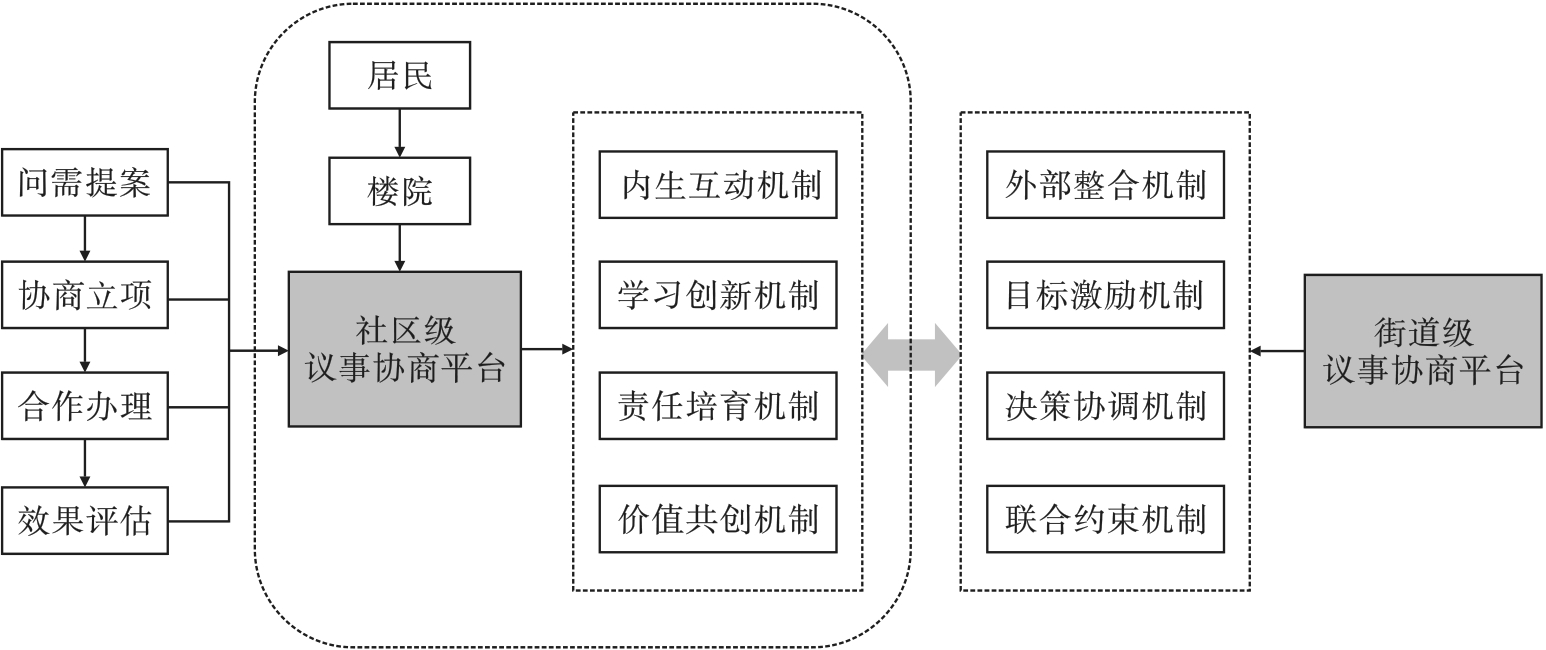
城市社区议事协商作为我国基层治理的重要实践形式,是中国特色社会主义协商民主在基层领域的生动体现,也是对“十五五”时期推进基层治理现代化的具体响应。基于行动者网络理论,构建了适用于阐释我国城市社区议事协商实践运行机制的统合性解释框架,并以B市Z社区为例开展实证研究。该框架通过“外部整合”与“内生互动”两组机制实现成员间的紧密联系和动态互动。在外部整合层面,行动者网络运用“目标激励机制”“决策协调机制”“联合约束机制”有效地连接政府服务与社区需求;在内生互动层面,行动者网络则通过“学习创新机制”“责任培育机制”“价值共创机制”推动网络成员公共精神的生发,形成议事协商发展的深层动力。由于城市社区议事协商制度持续维护居民的基本权利,所以,城市社区议事协商实践充分发挥了全过程人民民主的制度优势。

关键词: 社区议事协商, 基层治理, 协商民主, 行动者网络

Abstract:

Urban community deliberative consultation, as a pivotal form of grassroots governance in China, stands as a vivid embodiment of consultative democracy with Chinese characteristics at the grassroots level and a concrete response to advancing the modernization of grassroots governance during the 15th Five-Year Plan Period. Drawing on the actor-network theory, a comprehensive analytical framework is constructed tailored to interpreting the operational mechanism of urban community deliberative consultation in China, and an empirical investigation is conducted with Community Z in City B as the case study. The actor-network of urban community deliberative consultation achieves close connections and dynamic interactions among its members through two mechanisms: “external integration” and “endogenous interaction”. At the external integration level, the network employs “goal incentive mechanism”, “decision coordination mechanism”, and “joint restraint mechanism” to effectively link government services with community needs, while at the endogenous interaction level, the network promotes the development of public spirit among its members through “learning and innovation mechanism”, “responsibility cultivation mechanism”, and “value co-creation mechanism”, forming a deep driving force for the development of deliberative consultation. Due to the continuous maintenance of residents’ basic rights by the urban community deliberative consultation system, it has fully leveraged the institutional advantages of whole-process people’s democracy.

Key words: community deliberative consultation, grassroots governance, consultative democracy, actor-network theory

中图分类号: