
东北大学学报(自然科学版) ›› 2026, Vol. 47 ›› Issue (1): 1-10.DOI: 10.12068/j.issn.1005-3026.2026.20259022
• 智慧医疗专栏 • 下一篇
贾熹滨1( ), 尹训洁1, 范超1, 杨正汉2
收稿日期:2025-06-06
出版日期:2026-01-15
发布日期:2026-03-17
通讯作者:
贾熹滨
作者简介:贾熹滨(1969—),女,山西太原人,北京工业大学教授,博士生导师.
基金资助:
Xi-bin JIA1(), Xun-jie YIN1, Chao FAN1, Zheng-han YANG2
Received:2025-06-06
Online:2026-01-15
Published:2026-03-17
Contact:
Xi-bin JIA
摘要:
针对半监督病灶分割中教师网络性能较差,难以指导学生网络进行有效分割的问题,本文提出一种高效的半监督医学图像病灶分割方法.该方法选用特征提取能力更强的MedSAM(medical segment anything model)作为教师网络,构建基于Mamba的轻量级学生网络,通过知识蒸馏提升学生网络分割性能.针对异构网络特征对齐带来的语义失配问题,提出基于扰动一致的跨架构知识蒸馏策略,将教师特征映射到学生特征空间并对齐扰动响应,提升学生网络特征表达能力以优化分割性能.此外,针对病灶形态多样及前景背景对比度低导致的分割一致性差问题,提出基于分布的自监督损失进行优化.在多类医学图像病灶分割数据集上的实验表明,本文方法的分割性能优于现有方法,同时学生网络参数量仅为1.34 M,显著提升了模型效率.
中图分类号:
贾熹滨, 尹训洁, 范超, 杨正汉. 基于MedSAM的高效半监督医学图像病灶分割方法[J]. 东北大学学报(自然科学版), 2026, 47(1): 1-10.
Xi-bin JIA, Xun-jie YIN, Chao FAN, Zheng-han YANG. Efficient Semi-supervised Medical Image Lesion Segmentation Method Based on MedSAM[J]. Journal of Northeastern University(Natural Science), 2026, 47(1): 1-10.
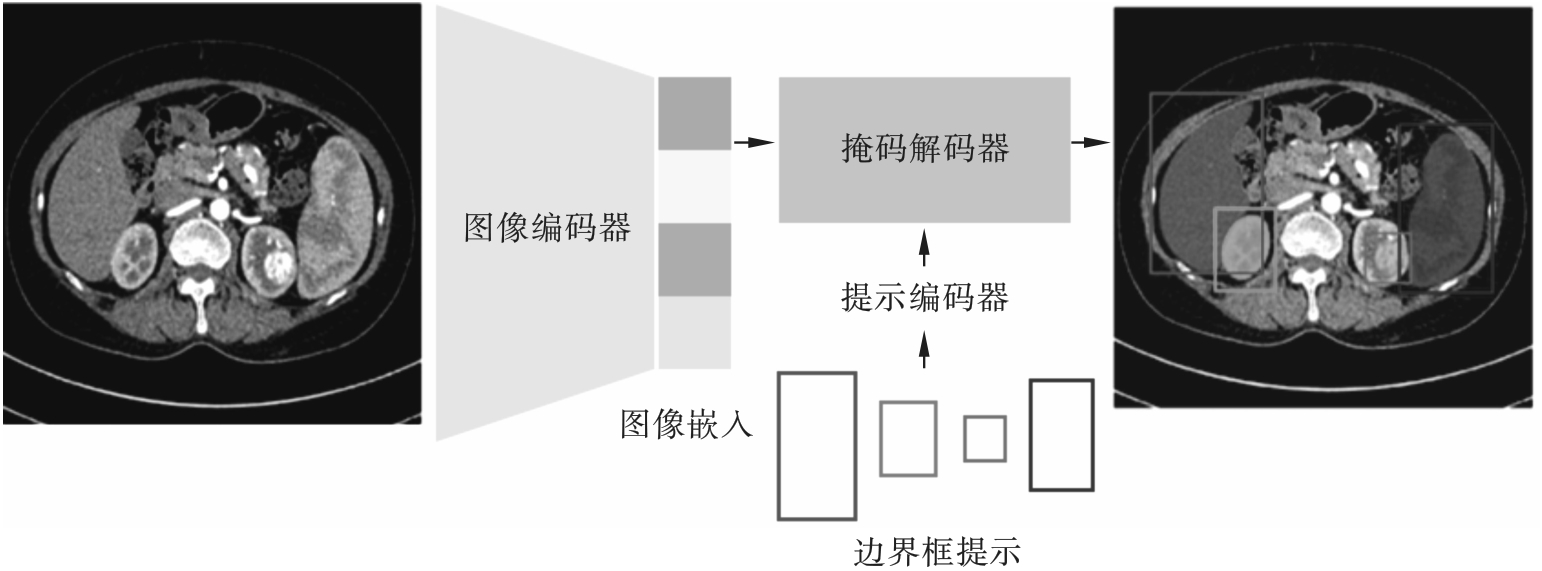
图1 MedSAM网络结构
Fig.1 MedSAM network structure
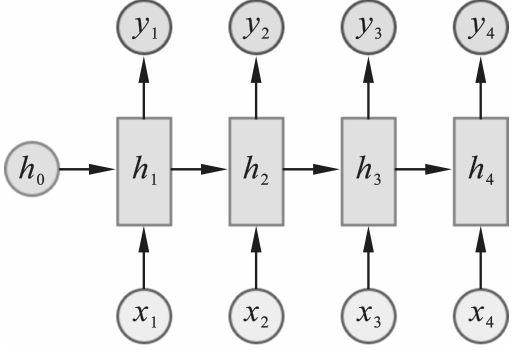
图2 Mamba状态空间模型
Fig.2 Mamba state space model
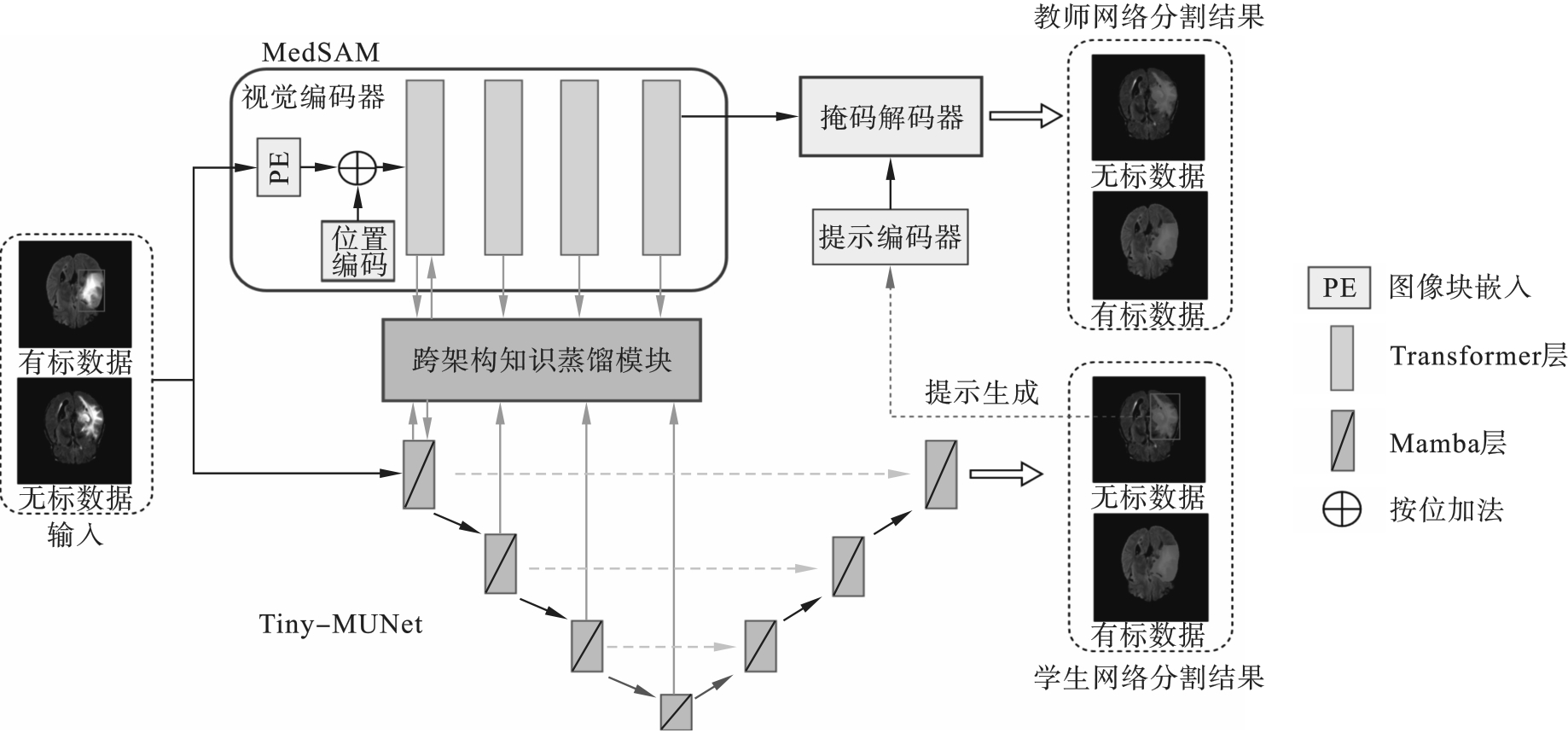
图3 基于MedSAM的半监督医学图像病灶分割网络框架
Fig.3 Semi-supervised medical image lesion segmentation network framework based on MedSAM
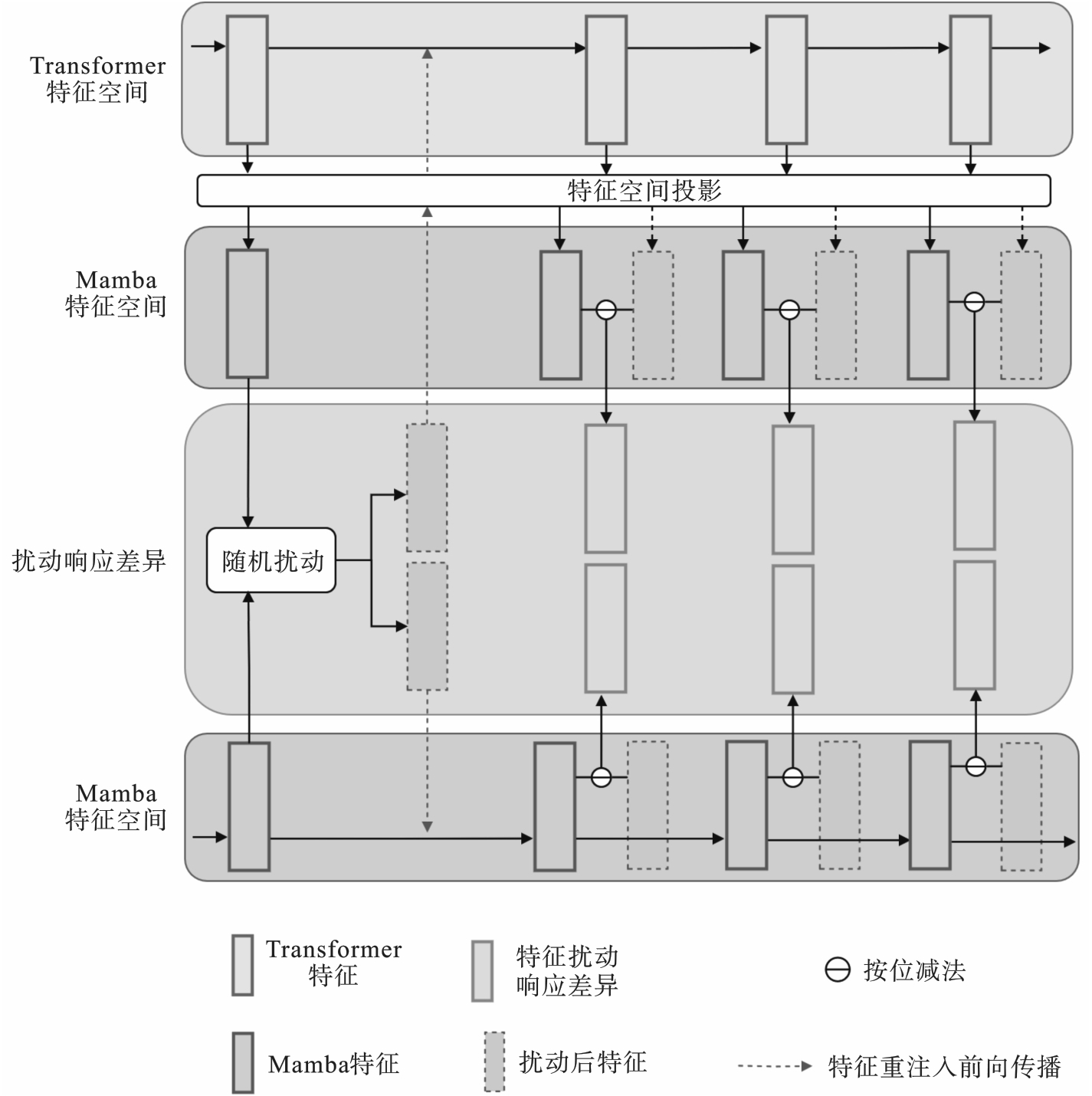
图4 跨架构知识蒸馏模块
Fig.4 Cross-architecture knowledge distillation module
| 方法 | 标注 比例/% | Dice | HD/像素↓ |
|---|---|---|---|
| Baseline U-Net | 100 | 80.28 | 15.24 |
| 10 | 64.48 | 20.53 | |
| 20 | 66.01 | 19.31 | |
| UA-MT | 10 | 70.12 | 17.65 |
| 20 | 72.29 | 16.18 | |
| SemiSAM-MT | 10 | 72.47 | 15.34 |
| 20 | 74.88 | 13.97 | |
| SASSNet | 10 | 70.04 | 19.58 |
| 20 | 71.61 | 17.66 | |
| URPC | 10 | 67.43 | 18.01 |
| 20 | 70.07 | 15.26 | |
| MC-Net+ | 10 | 72.89 | 15.52 |
| 20 | 73.27 | 13.86 | |
| BCP | 10 | 81.48 | 14.01 |
| 20 | 82.21 | 13.57 | |
| CauSSL | 10 | 80.18 | 14.25 |
| 20 | 81.93 | 13.87 | |
| BaPC | 10 | 80.29 | 13.96 |
| 20 | 81.47 | 13.08 | |
| CPC-SAM | 10 | 81.73 | 12.16 |
| 20 | 83.68 | 11.59 | |
| Ours | 10 | 83.46 | 13.60 |
| 20 | 85.65 | 12.34 |
表1 在MSD脑肿瘤分割数据集上的对比实验结果 (brain tumor segmentation dataset)
Table 1 Comparative experimental results on MSD
| 方法 | 标注 比例/% | Dice | HD/像素↓ |
|---|---|---|---|
| Baseline U-Net | 100 | 80.28 | 15.24 |
| 10 | 64.48 | 20.53 | |
| 20 | 66.01 | 19.31 | |
| UA-MT | 10 | 70.12 | 17.65 |
| 20 | 72.29 | 16.18 | |
| SemiSAM-MT | 10 | 72.47 | 15.34 |
| 20 | 74.88 | 13.97 | |
| SASSNet | 10 | 70.04 | 19.58 |
| 20 | 71.61 | 17.66 | |
| URPC | 10 | 67.43 | 18.01 |
| 20 | 70.07 | 15.26 | |
| MC-Net+ | 10 | 72.89 | 15.52 |
| 20 | 73.27 | 13.86 | |
| BCP | 10 | 81.48 | 14.01 |
| 20 | 82.21 | 13.57 | |
| CauSSL | 10 | 80.18 | 14.25 |
| 20 | 81.93 | 13.87 | |
| BaPC | 10 | 80.29 | 13.96 |
| 20 | 81.47 | 13.08 | |
| CPC-SAM | 10 | 81.73 | 12.16 |
| 20 | 83.68 | 11.59 | |
| Ours | 10 | 83.46 | 13.60 |
| 20 | 85.65 | 12.34 |
| 方法 | 标注 比例/% | Dice/%↑ | HD/像素↓ |
|---|---|---|---|
| Baseline U-Net | 100 | 78.57 | 10.24 |
| 10 | 72.47 | 16.16 | |
| 20 | 74.54 | 14.02 | |
| UA-MT | 10 | 79.15 | 15.45 |
| 20 | 81.84 | 12.30 | |
| SemiSAM-MT | 10 | 79.81 | 14.84 |
| 20 | 82.05 | 12.43 | |
| SASSNet | 10 | 82.93 | 15.75 |
| 20 | 83.36 | 11.61 | |
| URPC | 10 | 77.48 | 14.26 |
| 20 | 79.69 | 11.84 | |
| MC-Net+ | 10 | 83.71 | 12.62 |
| 20 | 84.24 | 11.04 | |
| BCP | 10 | 85.65 | 12.20 |
| 20 | 87.03 | 11.15 | |
| CauSSL | 10 | 86.25 | 11.52 |
| 20 | 87.56 | 10.36 | |
| BaPC | 10 | 85.87 | 13.84 |
| 20 | 87.40 | 11.28 | |
| CPC-SAM | 10 | 86.15 | 11.79 |
| 20 | 87.91 | 10.35 | |
| Ours | 10 | 87.58 | 10.06 |
| 20 | 90.32 | 9.84 |
表2 在HAM10000皮肤病数据集上的对比实验结果 (HAM10000 skin disease dataset)
Table 2 Comparative experimental results on
| 方法 | 标注 比例/% | Dice/%↑ | HD/像素↓ |
|---|---|---|---|
| Baseline U-Net | 100 | 78.57 | 10.24 |
| 10 | 72.47 | 16.16 | |
| 20 | 74.54 | 14.02 | |
| UA-MT | 10 | 79.15 | 15.45 |
| 20 | 81.84 | 12.30 | |
| SemiSAM-MT | 10 | 79.81 | 14.84 |
| 20 | 82.05 | 12.43 | |
| SASSNet | 10 | 82.93 | 15.75 |
| 20 | 83.36 | 11.61 | |
| URPC | 10 | 77.48 | 14.26 |
| 20 | 79.69 | 11.84 | |
| MC-Net+ | 10 | 83.71 | 12.62 |
| 20 | 84.24 | 11.04 | |
| BCP | 10 | 85.65 | 12.20 |
| 20 | 87.03 | 11.15 | |
| CauSSL | 10 | 86.25 | 11.52 |
| 20 | 87.56 | 10.36 | |
| BaPC | 10 | 85.87 | 13.84 |
| 20 | 87.40 | 11.28 | |
| CPC-SAM | 10 | 86.15 | 11.79 |
| 20 | 87.91 | 10.35 | |
| Ours | 10 | 87.58 | 10.06 |
| 20 | 90.32 | 9.84 |
| 方法 | 标准 比例/% | Dice/%↑ | HD/像素↓ |
|---|---|---|---|
| Baseline U-Net | 100 | 83.79 | 6.84 |
| 10 | 69.52 | 11.64 | |
| 20 | 73.27 | 7.01 | |
| UA-MT | 10 | 81.39 | 11.55 |
| 20 | 83.84 | 8.95 | |
| SemiSAM-MT | 10 | 81.64 | 10.48 |
| 20 | 83.46 | 9.77 | |
| SASSNet | 10 | 79.24 | 10.76 |
| 20 | 81.44 | 9.94 | |
| URPC | 10 | 78.04 | 16.97 |
| 20 | 79.58 | 13.58 | |
| MC-Net+ | 10 | 83.49 | 9.55 |
| 20 | 84.75 | 9.07 | |
| BCP | 10 | 81.32 | 10.12 |
| 20 | 83.12 | 9.53 | |
| CauSSL | 10 | 84.19 | 12.68 |
| 20 | 85.36 | 10.36 | |
| BaPC | 10 | 84.95 | 8.94 |
| 20 | 85.73 | 8.01 | |
| CPC-SAM | 10 | 83.68 | 10.24 |
| 20 | 85.07 | 9.64 | |
| Ours | 10 | 87.63 | 7.59 |
| 20 | 88.45 | 6.36 |
表3 在Kvasir-SEG数据集上的对比实验结果 (Kvasir-SEG dataset)
Table 3 Comparative experimental results on
| 方法 | 标准 比例/% | Dice/%↑ | HD/像素↓ |
|---|---|---|---|
| Baseline U-Net | 100 | 83.79 | 6.84 |
| 10 | 69.52 | 11.64 | |
| 20 | 73.27 | 7.01 | |
| UA-MT | 10 | 81.39 | 11.55 |
| 20 | 83.84 | 8.95 | |
| SemiSAM-MT | 10 | 81.64 | 10.48 |
| 20 | 83.46 | 9.77 | |
| SASSNet | 10 | 79.24 | 10.76 |
| 20 | 81.44 | 9.94 | |
| URPC | 10 | 78.04 | 16.97 |
| 20 | 79.58 | 13.58 | |
| MC-Net+ | 10 | 83.49 | 9.55 |
| 20 | 84.75 | 9.07 | |
| BCP | 10 | 81.32 | 10.12 |
| 20 | 83.12 | 9.53 | |
| CauSSL | 10 | 84.19 | 12.68 |
| 20 | 85.36 | 10.36 | |
| BaPC | 10 | 84.95 | 8.94 |
| 20 | 85.73 | 8.01 | |
| CPC-SAM | 10 | 83.68 | 10.24 |
| 20 | 85.07 | 9.64 | |
| Ours | 10 | 87.63 | 7.59 |
| 20 | 88.45 | 6.36 |
| 方法 | Para/M↓ | MACs/G↓ |
|---|---|---|
| MedSAM | 37.50 | 116.38 |
| U-Net | 3.27 | 12.54 |
| URPC | 1.82 | 11.02 |
| UA-MT | 3.27 | 13.76 |
| SASSNet | 3.27 | 11.71 |
| MC-Net+ | 3.21 | 15.26 |
| BCP | 5.69 | 16.61 |
| CauSSL | 4.36 | 15.92 |
| BaPC | 7.63 | 11.47 |
| Ours | 1.34 | 10.01 |
表4 不同方法在性能上的对比实验结果 (performance of different methods)
Table 4 Comparative experimental results on
| 方法 | Para/M↓ | MACs/G↓ |
|---|---|---|
| MedSAM | 37.50 | 116.38 |
| U-Net | 3.27 | 12.54 |
| URPC | 1.82 | 11.02 |
| UA-MT | 3.27 | 13.76 |
| SASSNet | 3.27 | 11.71 |
| MC-Net+ | 3.21 | 15.26 |
| BCP | 5.69 | 16.61 |
| CauSSL | 4.36 | 15.92 |
| BaPC | 7.63 | 11.47 |
| Ours | 1.34 | 10.01 |
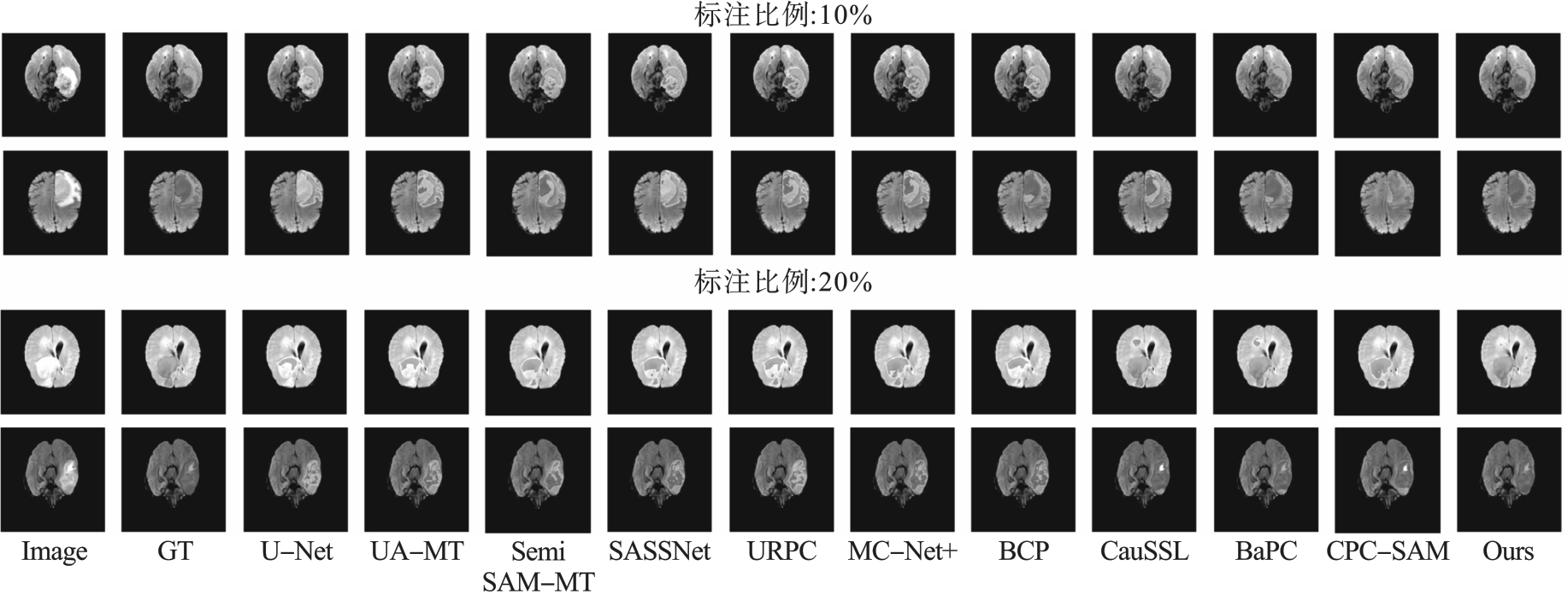
图5 不同方法在MSD数据集上的分割结果对比
Fig.5 Comparison of segmentation results of different methods on MSD datasets
| 方法 | (Dice/%)/(HD/像素) | ||
|---|---|---|---|
| MSD | HAM10000 | Kvasir-SEG | |
| w/o MedSAM | 57.12/30.82 | 70.34/27.96 | 60.21/20.48 |
| w/o FPKDM | 82.47/13.95 | 85.25/13.47 | 84.51/15.63 |
| w/o FBVM | 83.50/13.12 | 87.33/11.04 | 87.97/13.27 |
| Full | 85.65/12.34 | 90.32/9.84 | 88.45/6.36 |
表5 MSD脑肿瘤、HAM10000皮肤病和Kvasir-SEG数据集消融实验结果
Table 5 Ablation experiments results on MSD brain tumor, HAM10000 skin disease, and Kvasir-SEG datasets
| 方法 | (Dice/%)/(HD/像素) | ||
|---|---|---|---|
| MSD | HAM10000 | Kvasir-SEG | |
| w/o MedSAM | 57.12/30.82 | 70.34/27.96 | 60.21/20.48 |
| w/o FPKDM | 82.47/13.95 | 85.25/13.47 | 84.51/15.63 |
| w/o FBVM | 83.50/13.12 | 87.33/11.04 | 87.97/13.27 |
| Full | 85.65/12.34 | 90.32/9.84 | 88.45/6.36 |
| 轮次 | (Dice/%)/(HD/像素) | ||
|---|---|---|---|
| MSD | HAM10000 | Kvasir-SEG | |
| 10 | 85.54/13.02 | 88.74/10.18 | 88.31/6.77 |
| 20 | 85.58/12.79 | 88.76/9.97 | 88.40/6.54 |
| 30 | 85.51/12.71 | 88.84/10.01 | 88.47/6.39 |
| 40 | 85.59/12.28 | 89.97/9.93 | 88.43/6.40 |
| 0(Ours) | 85.65/12.34 | 90.32/9.84 | 88.45/6.36 |
表6 Tiny-MUNet初始性能对模型影响的消融实验 (MUNet initial performance on model)
Table 6 Ablation experiments on influence of Tiny-
| 轮次 | (Dice/%)/(HD/像素) | ||
|---|---|---|---|
| MSD | HAM10000 | Kvasir-SEG | |
| 10 | 85.54/13.02 | 88.74/10.18 | 88.31/6.77 |
| 20 | 85.58/12.79 | 88.76/9.97 | 88.40/6.54 |
| 30 | 85.51/12.71 | 88.84/10.01 | 88.47/6.39 |
| 40 | 85.59/12.28 | 89.97/9.93 | 88.43/6.40 |
| 0(Ours) | 85.65/12.34 | 90.32/9.84 | 88.45/6.36 |
| [1] | Tarvainen A, Valpola H. Mean teachers are better role models: weight-averaged consistency targets improve semi-supervised deep learning results[C]// Proceedings of the International Conference on Learning Representations. Vancouver, 2018:6-11. |
| [2] | Yu L Q, Wang S J, Li X M, et al. Uncertainty-aware self-ensembling model for semi-supervised 3D left atrium segmentation[C]//Medical Image Computing and Computer Assisted Intervention—MICCAI 2019. Cham: Springer, 2019: 605-613. |
| [3] | 赵小明, 石培炼, 王丹丹, 等. 分布感知均值教师网络的半监督医学影像分割[J]. 中国图象图形学报, 2025, 30(2): 575-588. |
| Zhao Xiao-ming, Shi Pei-lian, Wang Dan-dan, et al. Distribution-aware mean teacher networks for semi-supervised medical image segmentation[J]. Journal of Image and Graphics, 2025, 30(2): 575-588. | |
| [4] | Luo X D, Liao W J, Chen J N, et al. Efficient semi-supervised gross target volume of nasopharyngeal carcinoma segmentation via uncertainty rectified pyramid consistency[C]//Medical Image Computing and Computer Assisted Intervention—MICCAI 2021. Cham: Springer, 2021: 318-329. |
| [5] | 李飞翔, 降爱莲. MSMVT: 多尺度和多视图Transformer半监督医学图像分割框架[J]. 计算机工程与应用, 2025, 61(2): 273-282. |
| Li Fei-xiang, Jiang Ai-lian. MSMVT: semi-supervised framework with multi-scale and multi-view Transformer for medical image segmentation[J]. Computer Engineering and Applications, 2025, 61(2): 273-282. | |
| [6] | Li S L, Zhang C Y, He X M. Shape-aware semi-supervised 3D semantic segmentation for medical images[C]//Medical Image Computing and Computer Assisted Intervention—MICCAI 2020. Cham: Springer, 2020: 552-561. |
| [7] | Wu Y C, Ge Z Y, Zhang D H, et al. Mutual consistency learning for semi-supervised medical image segmentation[J]. Medical Image Analysis, 2022, 81: 102530. |
| [8] | Bai Y H, Chen D W, Li Q L, et al. Bidirectional copy-paste for semi-supervised medical image segmentation[C]//2023 IEEE/CVF Conference on Computer Vision and Pattern Recognition (CVPR). Vancouver, 2023: 11514-11524. |
| [9] | Chen X K, Yuan Y H, Zeng G, et al. Semi-supervised semantic segmentation with cross pseudo supervision[C]//2021 IEEE/CVF Conference on Computer Vision and Pattern Recognition (CVPR). Nashville, 2021: 2613-2622. |
| [10] | Ouali Y, Hudelot C, Tami M. Semi-supervised semantic segmentation with cross-consistency training[C]//2020 IEEE/CVF Conference on Computer Vision and Pattern Recognition (CVPR). Seattle,2020: 12671-12681. |
| [11] | 徐新辉, 曾智勇, 林征宇. 基于一致性正则化的半监督医学图像分割方法[J]. 中国医学物理学杂志, 2025, 42(6): 784-790. |
| Xu Xin-hui, Zeng Zhi-yong, Lin Zheng-yu. Semi-supervised medical image segmentation method based on consistency regularization[J]. Chinese Journal of Medical Physics, 2025, 42(6): 784-790. | |
| [12] | Miao J Z, Chen C, Zhang K L, et al. Cross prompting consistency with segment anything model for semi-supervised medical image segmentation[C]//Medical Image Computing and Computer Assisted Intervention—MICCAI 2024. Cham: Springer, 2024: 167-177. |
| [13] | Zhang Y C, Yang J, Liu Y C, et al. SemiSAM: enhancing semi-supervised medical image segmentation via SAM-assisted consistency regularization[C]//2024 IEEE International Conference on Bioinformatics and Biomedicine (BIBM). Lisbon, 2024: 3982-3986. |
| [14] | Miao J Z, Chen C, Liu F R, et al. CauSSL: causality-inspired semi-supervised learning for medical image segmentation[C]//2023 IEEE/CVF International Conference on Computer Vision (ICCV). Paris, 2023: 21369-21380. |
| [15] | Wang Y C, Xiao B, Bi X L, et al. Boundary-aware prototype in semi-supervised medical image segmentation[J]. IEEE Transactions on Image Processing, 2024, 33: 5456-5467. |
| [16] | Ma J, He Y T, Li F F, et al. Segment anything in medical images[J]. Nature Communications, 2024, 15(1): 654-659. |
| [17] | Liu Z, Lin Y T, Cao Y, et al. Swin Transformer: hierarchical vision transformer using shifted windows[C]//2021 IEEE/CVF International Conference on Computer Vision (ICCV). Montreal, 2022: 9992-10002. |
| [18] | Hatamizadeh A, Nath V, Tang Y C, et al. Swin UNETR: swin transformers for semantic segmentation of brain tumors in MRI images[C]//Brainlesion: Glioma, Multiple Sclerosis, Stroke and Traumatic Brain Injuries. Cham: Springer, 2022: 272-284. |
| [19] | Gu A, Dao T. Mamba: linear-time sequence modeling with selective state spaces[EB/OL]. (2023-12-01)[2024-12-24]. . |
| [20] | Gao J H, Cai Y H, Zhao Z K, et al. RGU-Mamba: an U-Mamba network with region-based training optimized for domain generalization applied to myocardial scar and edema segmentation[C]//Comprehensive Analysis and Computing of Real-World Medical Images. Cham: Springer, 2025: 77-86. |
| [21] | Jiao J B, Liu Y, Liu Y F, et al. VMamba: visual state space model[C]//Advances in Neural Information Processing Systems. Vancouver, 2024: 103031-103063. |
| [22] | Wu R K, Liu Y H, Liang P C, et al. H-vmunet: high-order vision Mamba UNet for medical image segmentation[J]. Neurocomputing, 2025, 624: 129447. |
| [23] | Fan C, Yu H Y, Huang Y, et al. SliceMamba with neural architecture search for medical image segmentation[J]. IEEE Journal of Biomedical and Health Informatics, 2025, 29(10): 7446-7458. |
| [24] | Hinton G, Vinyals O, Dean J. Distilling the knowledge in a neural network[EB/OL]. (2015-03-09)[2024-12-24] . . |
| [25] | Romero A, Ballas N, Kahou S E, et al. FitNets: hints for thin deep nets[EB/OL]. (2014-12-19)[2024-12-14]. . |
| [26] | Sun S Q, Cheng Y, Gan Z, et al. Patient knowledge distillation for BERT model compression[EB/OL]. (2019-08-25)[2024-12-24]. . |
| [27] | Hao Z, Guo J, Jia D, et al. Learning efficient vision transformers via fine-grained manifold distillation[C]//Advances in Neural Information Processing Systems. New Orleans, 2022: 9164-9175. |
| [28] | Zagoruyko S, Komodakis N. Paying more attention to attention: improving the performance of convolutional neural networks via attention transfer[EB/OL]. (2016-12-12)[2024-12-20]. . |
| [29] | Hao Z, Guo J, Han K, et al. One-for-all: bridge the gap between heterogeneous architectures in knowledge distillation[C]//Advances in Neural Information Processing Systems. New Orleans, 2023: 79570-79582. |
| [30] | Liu Y F, Cao J J, Li B, et al. Cross-architecture knowledge distillation[J]. International Journal of Computer Vision, 2024, 132(8): 2798-2824. |
| [31] | Zhai S W, Wang G T, Luo X D, et al. PA-seg: learning from point annotations for 3D medical image segmentation using contextual regularization and cross knowledge distillation[J]. IEEE Transactions on Medical Imaging, 2023, 42(8): 2235-2246. |
| [1] | 樊捷杰, 班晓娟, 张志研. 一种基于电子健康记录的多尺度图表示学习模型[J]. 东北大学学报(自然科学版), 2026, 47(1): 31-41. |
| [2] | 齐林, 高启赫, 关舒月, 李永春. 基于面部视频的非接触式血氧饱和度估计方法[J]. 东北大学学报(自然科学版), 2026, 47(1): 42-51. |
| [3] | 刘纪红, 时瑞瑞. 基于YOLOv8改进的无人机视觉小目标检测模型[J]. 东北大学学报(自然科学版), 2025, 46(12): 29-37. |
| [4] | 车晓辰, 马淑华, 郭泽旭, 沙晓鹏. 基于改进YOLOv8算法的复杂场景船舶目标检测[J]. 东北大学学报(自然科学版), 2025, 46(12): 38-47. |
| [5] | 吕真真, 房立金, 赵乾坤, 万应才. 基于改进的YOLOv8的PCB瑕疵检测[J]. 东北大学学报(自然科学版), 2025, 46(10): 1-9. |
| [6] | 沙晓鹏, 谢德瀚, 郭周鹏, 孙凯. LIDD-Net:基于深度学习的轻量级工业产品缺陷检测方法[J]. 东北大学学报(自然科学版), 2025, 46(10): 18-26. |
| [7] | 邹慧, 佘黎煌, 陈烨涵, 乐意. 基于几何注意力机制的三维手部姿势估计算法[J]. 东北大学学报(自然科学版), 2025, 46(10): 44-50. |
| [8] | 于连江, 刘洪娟. 基于线性变换余弦球面分布的光照估计方法[J]. 东北大学学报(自然科学版), 2025, 46(9): 34-40. |
| [9] | 李立振, 马淑华, 郭泽旭, 车晓辰. 基于X-ray-RTDETR的X射线图像违禁品检测算法[J]. 东北大学学报(自然科学版), 2025, 46(6): 8-15. |
| [10] | 刘佳彤, 王丽娜, 汪润, 叶茜. 基于面部掩码引导的多人场景图像伪造定位算法[J]. 东北大学学报(自然科学版), 2025, 46(5): 10-19. |
| [11] | 单鹏, 张林, 肖洪明, 赵玉良. 融合多尺度注意力机制的冠状病毒肺炎CT诊断方法[J]. 东北大学学报(自然科学版), 2024, 45(12): 1673-1679. |
| [12] | 沙晓鹏, 曹加奇, 李文静, 秦晔. 单目视频图像序列三维重建方法[J]. 东北大学学报(自然科学版), 2024, 45(12): 1680-1687. |
| [13] | 马淑华, 李立振, 秦汉民, 沙晓鹏. 基于PP-PicoDet-XS的改进铝型材表面缺陷检测算法[J]. 东北大学学报(自然科学版), 2024, 45(11): 1557-1564. |
| [14] | 刘纪红, 黄熙雄. 基于去噪扩散概率模型的人脸图像修复模型[J]. 东北大学学报(自然科学版), 2024, 45(9): 1227-1234. |
| [15] | 刘伟嵬, 邱佳鹤, 胡光大, 刘泽远. 基于改进YOLOv5的退役轴类零件表面损伤检测方法[J]. 东北大学学报(自然科学版), 2024, 45(7): 1002-1010. |
| 阅读次数 | ||||||
|
全文 |
|
|||||
|
摘要 |
|
|||||
