Journal of Northeastern University(Natural Science) ›› 2025, Vol. 46 ›› Issue (10): 10-17.DOI: 10.12068/j.issn.1005-3026.2025.20240057
• Information & Control • Previous Articles
Hai ZHAO, Shu-kun YANG, Jiu-nan MIAO, Xue-long YU
Received:
Online:
Published:
Abstract:
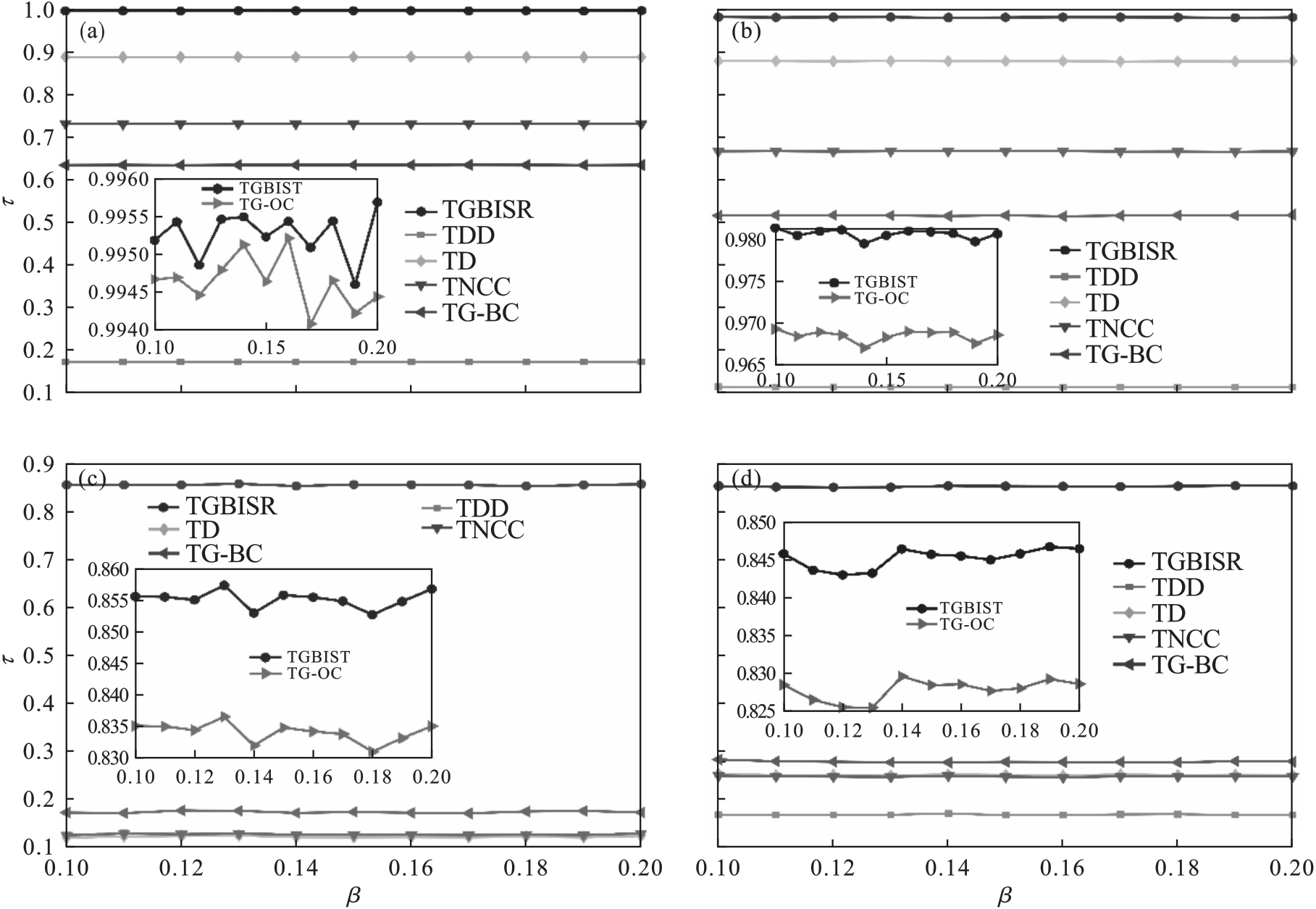
Accurately identifying influential spreaders in temporal networks is crucial for product promotion, rumor suppression, and other aspects. Existing methods mostly rely on a single feature (the number of neighbors, node location, or propagation ability) and ignore interactions between features, resulting in low accuracy. Therefore, a temporal gravity(TG)model and an information entropy-based identification method(TGBISR)were proposed to improve identification accuracy by fusing multiple features. First, the TG model was used to analyze the degree centrality, closeness centrality, and betweenness centrality of the user, portraying their local, positional, and global features, respectively. Then, the information content of each feature was measured through information entropy, and different weights were assigned to them to comprehensively compute the user’s influence. To verify the result, the susceptible-infected-recovered (SIR) model was used to simulate information dissemination on four real datasets to obtain the real influence of users. The correlation between the TGBISR calculation results and the real values was then compared using Kendall’s correlation coefficient and regression analysis. The experimental results show that the TGBISR method’s calculated results exhibit a higher statistical correlation with the true influence of the SIR model when identifying influential spreaders, and its accuracy significantly and consistently outperforms that of the other five benchmark algorithms.
Key words: temporal network, influential spreader, temporal gravity model, information entropy
CLC Number:
TP 301.6
Hai ZHAO, Shu-kun YANG, Jiu-nan MIAO, Xue-long YU. Comprehensive Identification of Influential Spreaders in Temporal Networks Considering Multiple Features[J]. Journal of Northeastern University(Natural Science), 2025, 46(10): 10-17.
0 / / Recommend
Add to citation manager EndNote|Ris|BibTeX
URL: https://xuebao.neu.edu.cn/natural/EN/10.12068/j.issn.1005-3026.2025.20240057
https://xuebao.neu.edu.cn/natural/EN/Y2025/V46/I10/10
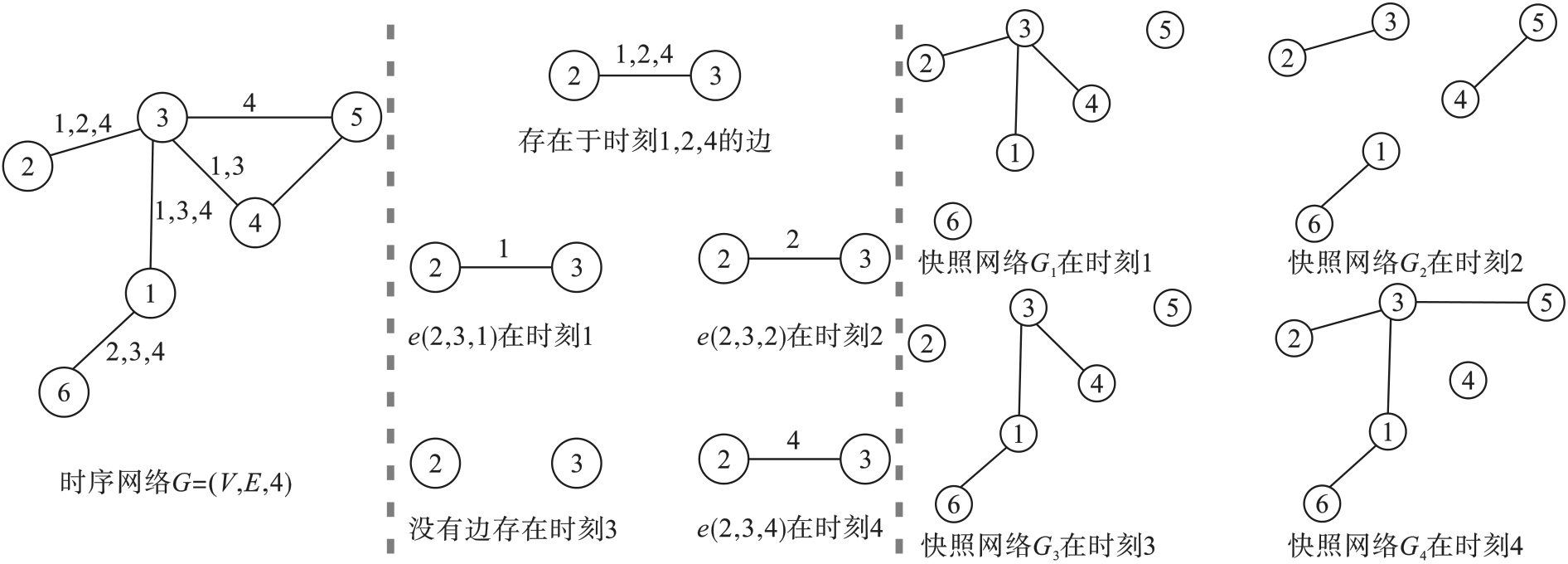
Fig.1 Temporal network with 6 nodes and 4 time steps
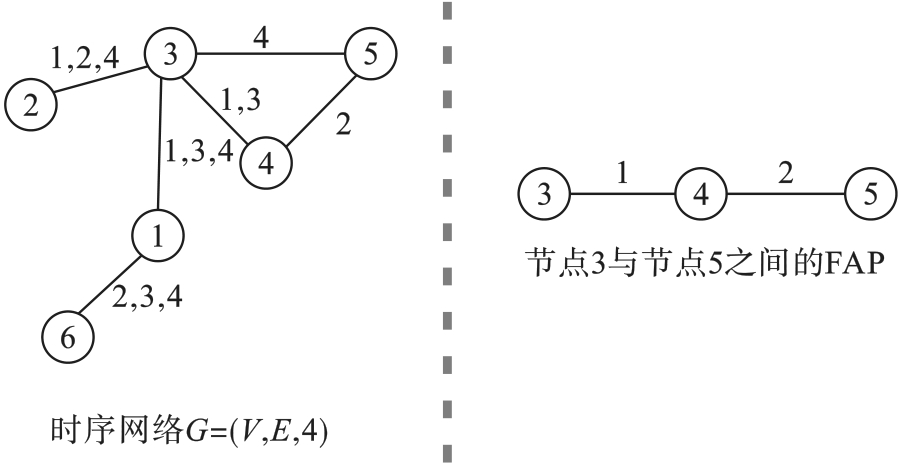
Fig.2 FAP
输入: 时序网络G,节点数量 N
输出: 节点中心性序列C
1. 生成决策矩阵 X=(xij)N×3;
2. fori←1,2,…,N do
3. xi1←TG-DC(vi), xi2←TG-CC(vi);
4. xi3←TG-BC(vi);
5. S1←0, S2←0, S3←0;
6. fori←1,2,…,Ndo
7. forj←1,2,3do
8. Sj←Sj+xij2;
9. fori←1,2,…,Ndo
10. forj←1,2,3do
11. xij'←xijSj;
12. xi'←(xi1',xi2',xi3');
13. X'←[x1',x2',…,xN']T;
14. F1←0,F2←0,F3←0forj←1,2,3do
15. fori←1,2,…,Ndo
16. Fj←Fj-1lnN∑i=1Nxij'×lnxij';
17. ω1←F1∑k=13Fk,ω2←F2∑k=13Fk,ω3←F3∑k=13Fk;
18. ω←(ω1,ω2,ω3)Tforeachxi' in X'do
19. C(vi)←xi'×ω;
20. C←(C(v1),C(v2),…,C(vN))T;
21. 将C中所有的元素排序
Table 1 TGBISR algorithm
Table 2 Statistical characteristics of real data
Fig.3 Kendall coefficient of six algorithms in four social networks