
Journal of Northeastern University(Natural Science) ›› 2025, Vol. 46 ›› Issue (11): 66-72.DOI: 10.12068/j.issn.1005-3026.2025.20240111
• Materials & Metallurgy • Previous Articles Next Articles
Guo-peng ZHANG1, Feng-man SHEN1( ), Wei-ling ZHANG1,2, Hai-yan ZHENG1
Received:2024-05-14
Online:2025-11-15
Published:2026-02-07
Contact:
Feng-man SHEN
CLC Number:
Guo-peng ZHANG, Feng-man SHEN, Wei-ling ZHANG, Hai-yan ZHENG. Research on Mechanism and Influencing Factors of TiO2 Carbothermal Reduction[J]. Journal of Northeastern University(Natural Science), 2025, 46(11): 66-72.
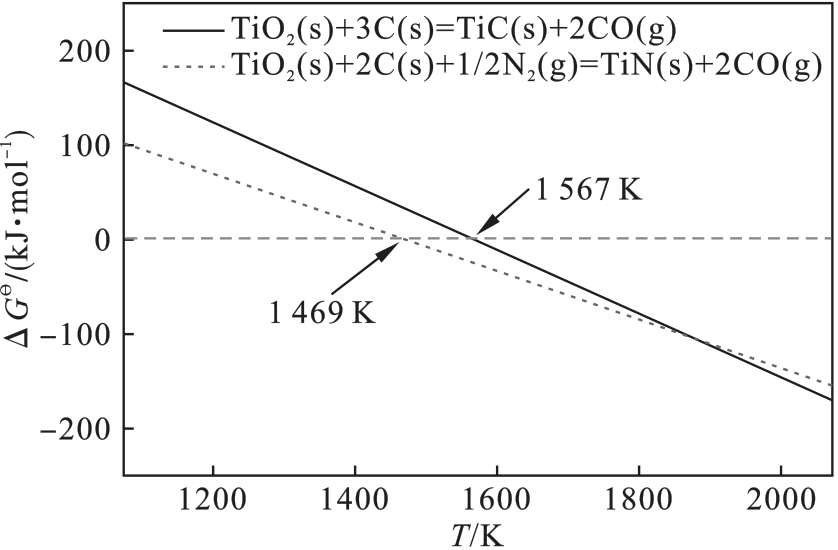
Fig.1 Standard Gibbs free energy variation for TiN and TiC generation
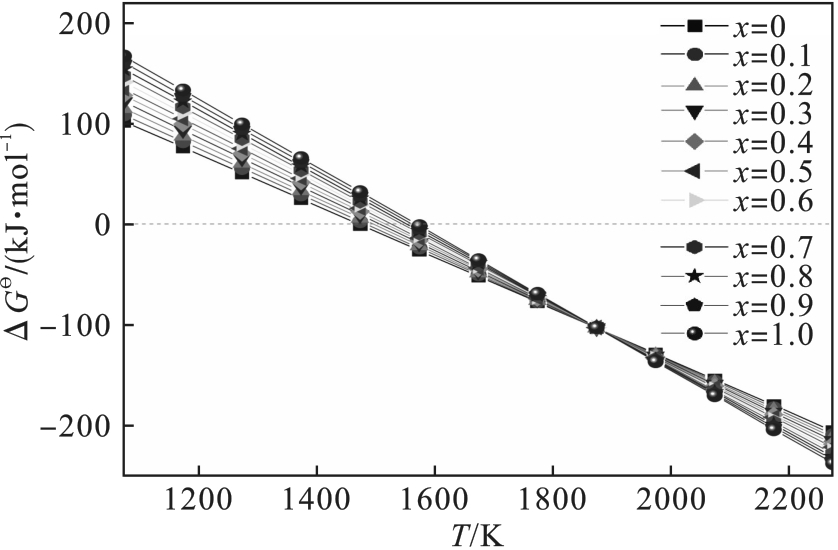
Fig.2 Standard Gibbs free energy of Ti(C x, N y ) solid solution generation for different molar fractions of TiC
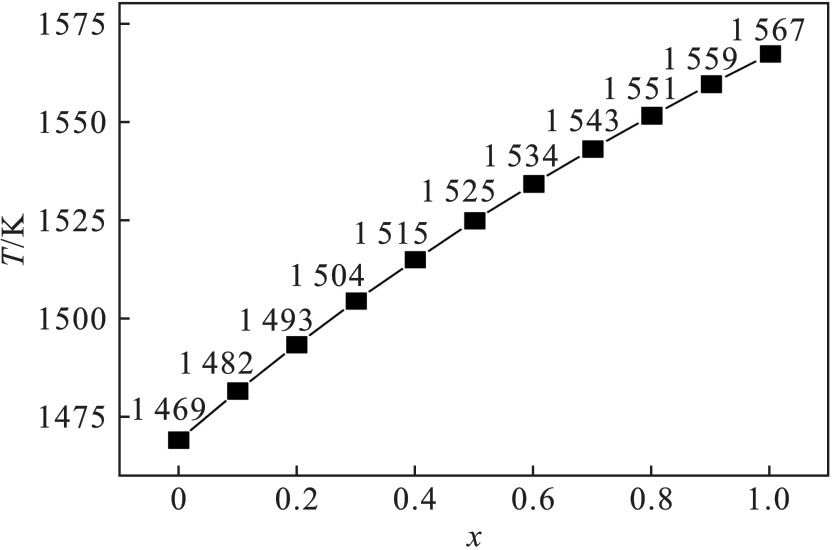
Fig.3 Initial reaction temperatures for Ti(C x, N y ) solid solution generation with different molar fractions of TiC
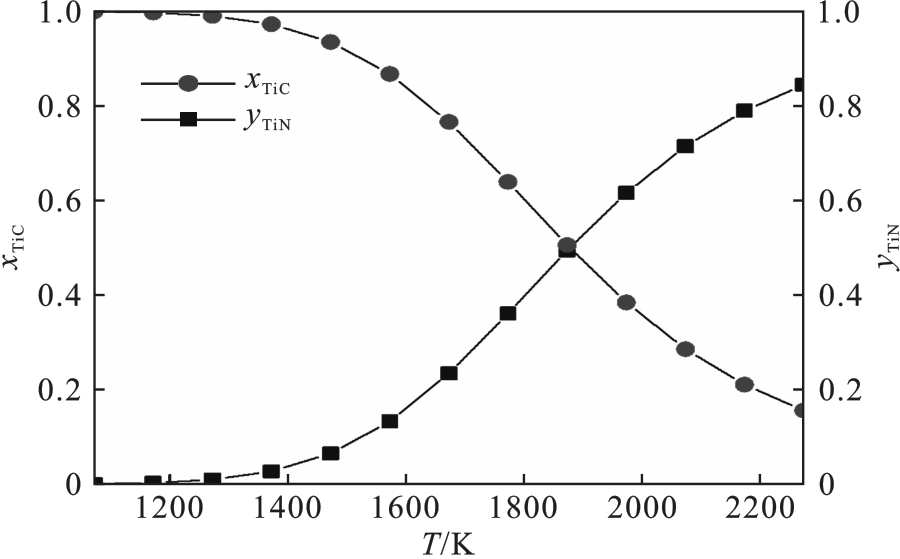
Fig.4 Variation of TiC and TiN mole fractions in Ti(C x, N y ) solid solution with temperature at N2 partial pressure of 101.325 kPa
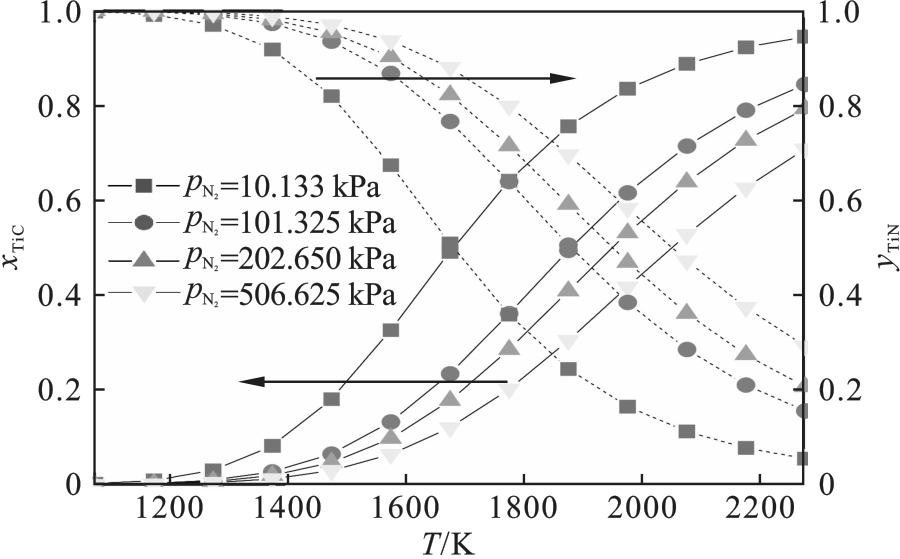
Fig.5 Variation of TiC and TiN mole fractions in Ti(C x, N y ) solid solution with temperature at different N2 partial pressures
| 样品编号 | 成分组成 | 配比 |
|---|---|---|
| TSM1 | TiO2+石墨 | 1∶3.3 |
| TJT2 | TiO2+焦炭 | 1∶3.3 |
| TYM3 | TiO2+烟煤 | 1∶3.3 |
| TWYM4 | TiO2+无烟煤 | 1∶3.3 |
Table 1 Composition ratios of test samples
| 样品编号 | 成分组成 | 配比 |
|---|---|---|
| TSM1 | TiO2+石墨 | 1∶3.3 |
| TJT2 | TiO2+焦炭 | 1∶3.3 |
| TYM3 | TiO2+烟煤 | 1∶3.3 |
| TWYM4 | TiO2+无烟煤 | 1∶3.3 |
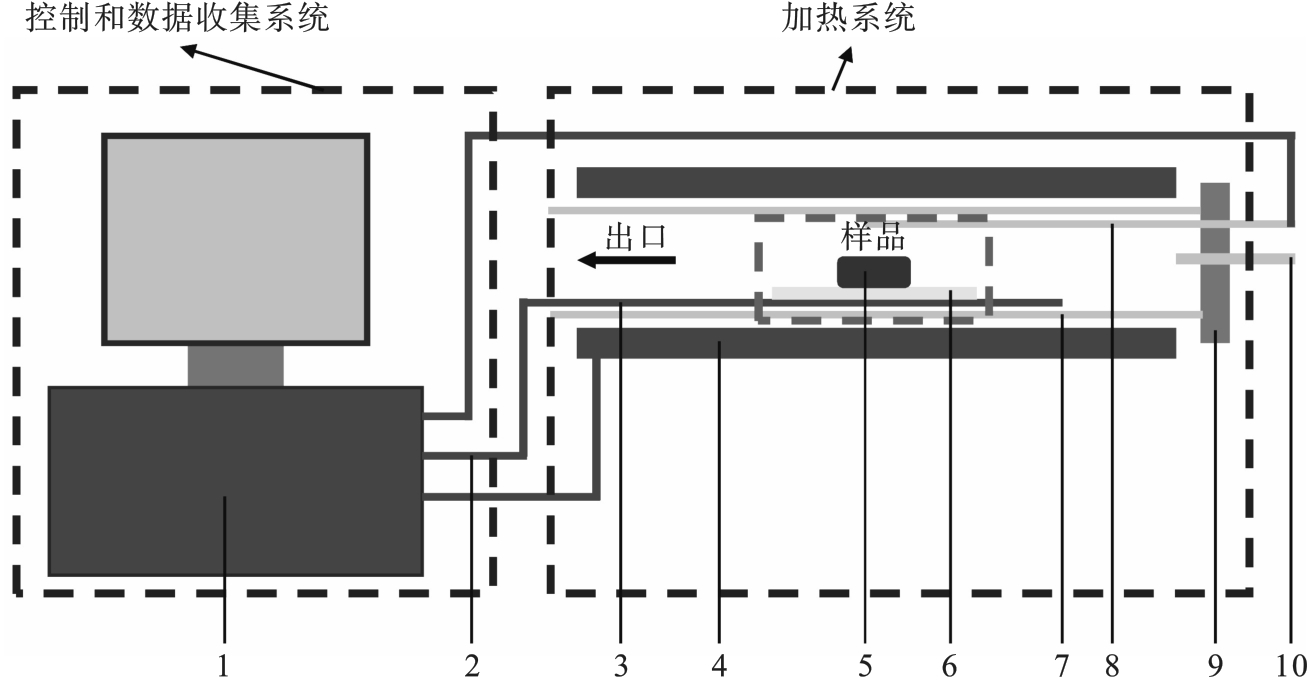
Fig. 6 Schematic diagram of test equipment
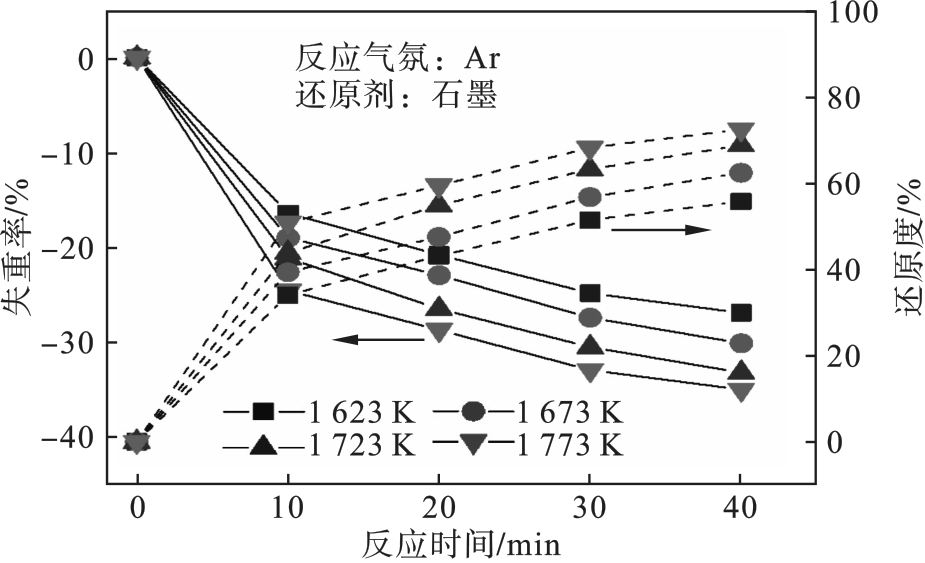
Fig.7 Variation of weight loss rate and reduction degree of samples after carbothermal reduction of TiO2 at different temperatures
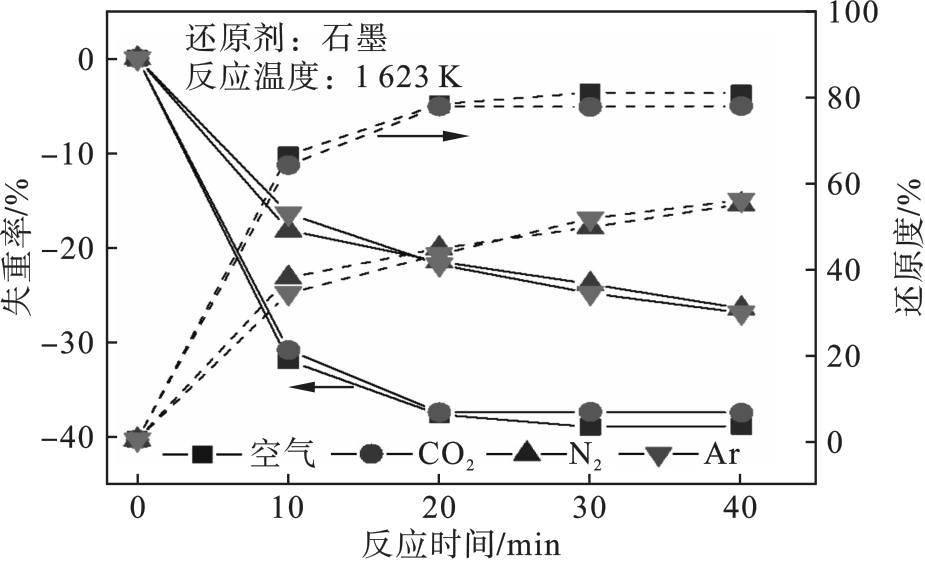
Fig.8 Variation of weight loss rate and reduction degree in carbothermal reduction reaction of TiO2 under different atmosphere conditions
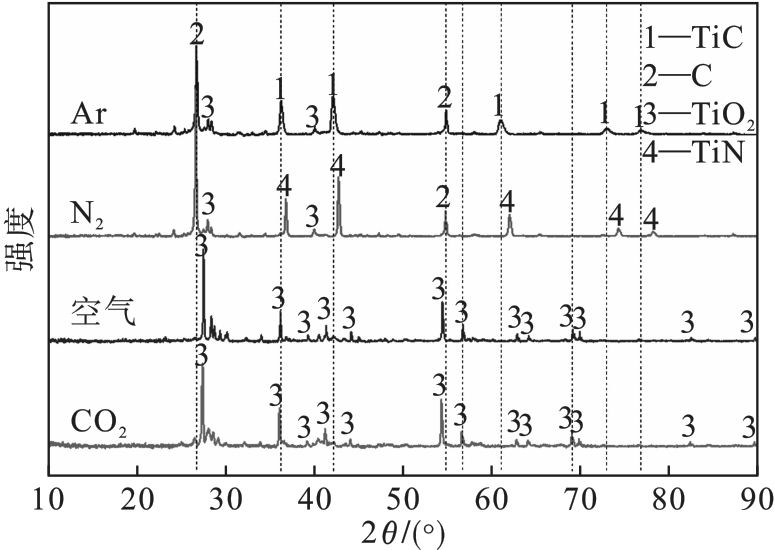
Fig.9 Physical phase analysis of samples after carbothermal reduction of TiO2 under different atmosphere conditions
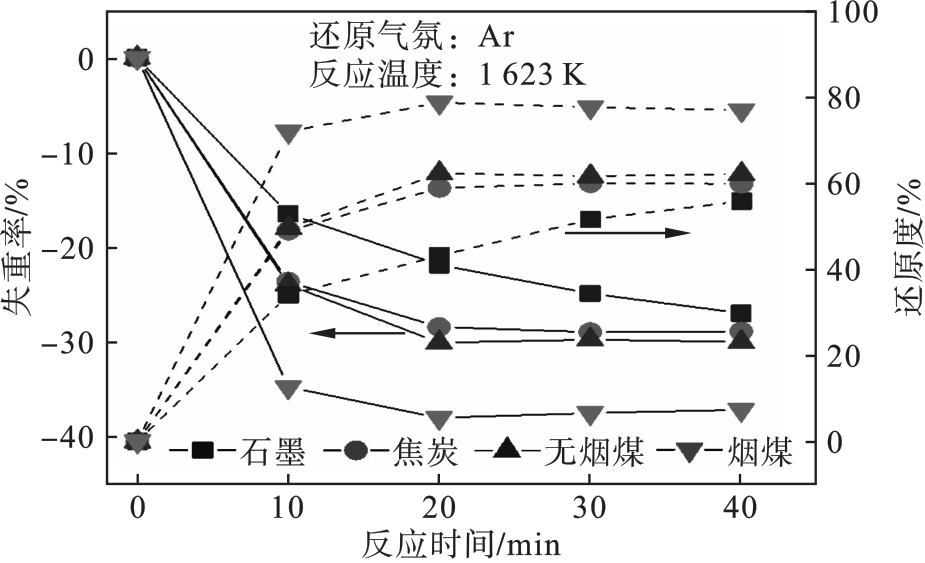
Fig.10 Variation of weight loss rate and reduction degree in carbothermal reduction reaction of TiO2 under different reductant conditions
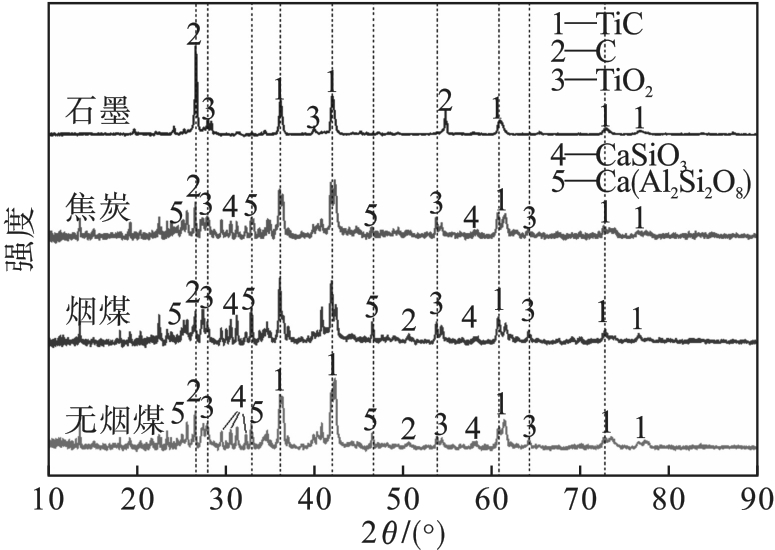
Fig.11 Physical phase analysis of samples after carbothermal reduction reaction of TiO2 under different reductant conditions
| [1] | Chen D S, Song B, Wang L N, et al. Solid state reduction of Panzhihua titanomagnetite concentrates with pulverized coal[J]. Minerals Engineering, 2011, 24(8):864-869. |
| [2] | Zhang L, Zhang L N, Wang M Y, et al. Precipitation selectivity of perovskite phase from Ti-bearing blast furnace slag under dynamic oxidation conditions[J]. Journal of Non-Crystalline Solids, 2007, 353(22/23):2214-2220. |
| [3] | Pang Z D, Jiang Y Y, Ling J W, et al. Blast furnace ironmaking process with super high TiO2 in the slag: density and surface tension of the slag[J]. International Journal of Minerals, Metallurgy and Materials, 2022,29(6):1170-1178. |
| [4] | Valighazvini F, Rashchi F, Khayyam Nekouei R. Recovery of titanium from blast furnace slag[J]. Industrial & Engineering Chemistry Research, 2013, 52(4):1723-1730. |
| [5] | Yuan Z F, Wang X Q, Xu C, et al. A new process for comprehensive utilization of complex titania ore[J]. Minerals Engineering, 2006, 19(9):975-978. |
| [6] | Saito N, Hori N, Nakashima K, et al. Viscosity of blast furnace type slags[J]. Metallurgical and Materials Transactions B, 2003, 34(5):509-516. |
| [7] | Zheng H Y, Zhou S F, Zhang S, et al. Viscosity estimation of TiO2-bearing blast furnace slag with high Al2O3 at 1 500 oC[J]. Metals, 2023, 13(3):573. |
| [8] | Shankar A, Görnerup M, Seetharaman S, et al. Sulfide capacity of high alumina blast furnace slags[J]. Metallurgical and Materials Transactions B, 2006, 37(6):941-947. |
| [9] | Sohn I, Wang W L, Matsuura H, et al. Influence of TiO2 on the viscous behavior of calcium silicate melts containing 17 mass% Al2O3 and 10 mass% MgO[J]. ISIJ International, 2012, 52(1):158-160. |
| [10] | Zheng H Y, Zhou X R, Hu X G, et al. Desulphurisation behaviour of blast furnace slag with high Al2O3 content at 1823 K[J]. Ironmaking & Steelmaking, 2022,49(6):596-603. |
| [11] | Gao K, Jiao K X, Zhang J L, et al. Dissection investigation of forming process of titanium compounds layer in the blast furnace hearth[J]. ISIJ International, 2020, 60(11): 2385-2391. |
| [12] | Qiu G B, Ma S W, Deng Q Y, et al. Study on the formation of Ti(C,N) between blast furnace hot metal and slag bearing high TiO2 [J]. Metalurgia International, 2012, 17(4): 94-99. |
| [13] | Narita K, Maekawa M, Onoye T, et al. Formation of titanium compounds, so-called titanium bear, in the blast furnace hearth[J]. Transactions of the Iron and Steel Institute of Japan, 1977, 17(8):459-468. |
| [14] | Zhen Y L, Zhang G H, Chou K C. Carbothermic reduction of titanium-bearing blast furnace slag[J]. High Temperature Materials and Processes, 2016, 35(3): 309-319. |
| [15] | 张建良,焦克新,刘征建,等.长寿高炉炉缸保护层综合调控技术[J].钢铁,2017, 52(12):1-7. |
| Zhang Jian-liang, Jiao Ke-xin, Liu Zheng-jian, et al. Comprehensive regulation technology for hearth protective layer of blast furnace longevity[J]. Iron and Steel, 2017, 52(12):1-7. | |
| [16] | 赵永彬,张建良,宁晓钧,等.低钛高炉渣中Ti(C,N)形成的研究[J].钢铁钒钛,2014, 35(1):79-84. |
| Zhao Yong-bin, Zhang Jian-liang, Ning Xiao-jun, et al. Study on the formation of Ti(C,N) in low TiO2 content blast furnace slag[J]. Iron Steel Vanadium Titanium, 2014, 35(1):79-84. | |
| [17] | 高运明,李慈颖,李亚伟,等.TiO2碳热还原与高炉钛渣提取碳氮化钛分析[J].武汉科技大学学报(自然科学版),2007, 30(1):5-9. |
| Gao Yun-ming, Li Ci-ying, Li Ya-wei, et al. Analysis of carbothermal reduction of TiO2 and extraction of titanium carbonitride from the blast furnace slag bearing titania[J]. Journal of Wuhan University of Science and Technology(Natural Science Edition),2007, 30(1):5-9. | |
| [18] | Wang Y Z, Zhang J L, Liu Z J, et al. Carbothermic reduction reactions at the metal-slag interface in Ti-bearing slag from a blast furnace[J]. JOM, 2017, 69(11):2397-2403. |
| [19] | Jiao K X, Zhang J L, Hou Q F, et al. Analysis of the relationship between productivity and hearth wall temperature of a commercial blast furnace and model prediction[J]. Steel Research International, 2017,88(9): 1600475. |
| [20] | Jiao K X, Zhang J L, Liu Z J, et al. Dissection investigation of Ti(C, N) behavior in blast furnace hearth during vanadium titano-magnetite smelting[J]. ISIJ International, 2017, 57(1): 48-54. |
| [21] | 詹星.小高炉冶炼钒钛磁铁矿解剖研究[J].钢铁钒钛,1984, 5(2):3-15. |
| Zhan Xing. Anatomical study on smelting vanadium-titanium magnetite in small blast furnace[J]. Iron Steel Vanadium Titanium, 1984, 5(2):3-15. | |
| [22] | 郑常乐,邵球军,张建良,等.富氧率对钒钛磁铁矿球团还原行为的影响[J].东北大学学报(自然科学版),2016, 37(2): 198-202, 212. |
| Zheng Chang-le, Shao Qiu-jun, Zhang Jian-liang, et al. Influence of oxygen enrichment rate on reduction behavior of titanomagnetite pellets[J]. Journal of Northeastern University (Natural Science),2016, 37(2): 198-202, 212. | |
| [23] | 焦克新,张建良,刘征建,等.高炉炉缸含钛保护层物相及TiC0.3N0.7形成机理[J].工程科学学报,2019, 41(2):190-198. |
| Jiao Ke-xin, Zhang Jian-liang, Liu Zheng-jian, et al. Mineralogical phase and formation mechanism of titanium-bearing protective layers in a blast furnace hearth[J]. Chinese Journal of Engineering, 2019, 41(2):190-198. | |
| [24] | 焦克新,张建良,左海滨,等.高炉炉缸黏滞层物相及形成机理[J].东北大学学报(自然科学版),2014, 35(7):987-991. |
| Jiao Ke-xin, Zhang Jian-liang, Zuo Hai-bin, et al. Composition and formation mechanism of viscous layers in blast furnace hearth[J]. Journal of Northeastern University (Natural Science), 2014, 35(7):987-991. | |
| [25] | Wada H, Pehlke R D. Nitrogen solubility and nitride formation in austenitic Fe-Ti alloys[J]. Metallurgical Transactions B, 1985, 16(4): 815-822. |
| [26] | Ozturk B, Fruehan R J. Thermodynamics of inclusion formation in Fe-Ti-C-N alloys[J]. Metallurgical Transactions B, 1990, 21(5): 879-884. |
| [27] | Li Y, Li Y Q, Fruehan R J. Formation of titanium carbonitride from hot metal[J]. ISIJ International, 2001,41(12):1417-1422. |
| [28] | Xiang D W, Shen F M, Jiang X, et al. Pyrolysis characteristics of industrial lignin for use as a reductant and an energy source for future iron making[J]. ACS Omega, 2021,6(5): 3578-3586. |
| [29] | Lyu T T, Hu T, Tian F. Hydrogen-enhanced carbothermal reduction for the synthesis of TiC from TiO2 [J]. Journal of Alloys and Compounds, 2025, 1039: 183002. |
| [30] | Tang S Y, Song G Q, Guo J J, et al. Oxidation behavior of TiC and TiCN and their potential photocatalytic activity in semi-oxidized state[J]. Nanoscale Advances, 2025,7(16): 5031-5041. |
| [31] | Chen M, Chen B X, Jiang Y, et al. Study of Ti(C,N) formations in TiO2-containing slags[J]. Metallurgical and Materials Transactions B, 2025, 56(1): 1018-1028. |
| [32] | Sui J H, Yang S T, Wang Q, et al. Influence of blast furnace burden with different TiO2 contents on the process of reduction and slag formation in cohesive zone[J]. ISIJ International, 2025,65(4): 521-532. |
| [33] | Zhang S S, Zhang J L, Wang Z Y, et al. Advancements in oxygen blast furnace technology and its application in the smelting of vanadium-titanium magnetite: a comprehensive review[J]. Minerals Engineering, 2024, 212: 108732. |
| [34] | Huang Y, Zhang Z D, Tang J, et al. Mathematical simulation on smelting vanadium-bearing titanomagnetite by oxygen blast furnace[J]. ISIJ International, 2025,65(11): 1690-1700. |
| [35] | Chen B X, Chen M, Zhang K X, et al. Metallurgical properties of vanadium titanomagnetite sinter in the cohesive zone of H2-rich oxygen blast furnace[J]. Metallurgical and Materials Transactions B, 2025: 1-12. |
| [36] | Qu Y X, Xing L, Gao M L, et al. Progress and prospects for titanium extraction from titanium-bearing blast furnace slag[J]. Materials, 2024, 17(24): 6291. |
| [37] | Zheng K, Wang W, Huang T, et al. Influence of temperature and slag composition on wetting behavior of titanium-containing blast furnace slag and tuyere coke[J]. Journal of Iron and Steel Research International, 2025,32(10): 3298-3307. |
| [1] | Xiao-zhou CAO, Sheng-qi SHAO, Hong-rui YUE. Diffusion Reaction Characteristics of Calcium Ferrite and TiO2 [J]. Journal of Northeastern University(Natural Science), 2024, 45(2): 193-200. |
| [2] | ZHANG Li-heng, GAO Zi-xian, TANG Wei-dong, XUE Xiang-xin. Effect of TiO2 Content on Metallurgy Performance of High-Chromium Vanadium-Titanium Magnetite Sinter [J]. Journal of Northeastern University Natural Science, 2020, 41(11): 1667-1672. |
| [3] | BIAN Xue, HU Lyu, PENG Peng, LIU Si-yang. Preparation and Properties of xCeO2-yWO3-TiO2 Denitration Catalyst [J]. Journal of Northeastern University Natural Science, 2019, 40(12): 1716-1720. |
| [4] | JIANG Ting-ting, SHI Yong, KE Jun, XU Kai-li. TiO2 Photocatalyst Modified by Carbon Quantum Dots and Its Activity in Pollutants Degradation [J]. Journal of Northeastern University Natural Science, 2018, 39(1): 138-142. |
| [5] | LI Wei, FU Gui-qin, CHU Man-sheng, ZHU Miao-yong. Phase Transformation and Non-isothermal Oxidation Kinetics of Hongge Vanadium-Bearing Titanomagnetite [J]. Journal of Northeastern University Natural Science, 2017, 38(4): 517-521. |
| [6] | WANG Yan-xiu, ZHANG Ting-an, LYU Guo-zhi, ZHU Xiao-feng. Reaction Behaviors of CaO-TiO2-SiO2-NaAlO2 System [J]. Journal of Northeastern University Natural Science, 2015, 36(5): 685-689. |
| [7] | SUN Yu, DONG Yue, ZHENG Hai-yan, SHEN Feng-man. Experimental Study on Direction Reduction of Vanadium-Bearing Titanomagnetite [J]. Journal of Northeastern University Natural Science, 2015, 36(1): 63-67. |
| Viewed | ||||||
|
Full text |
|
|||||
|
Abstract |
|
|||||
