
Journal of Northeastern University(Natural Science) ›› 2025, Vol. 46 ›› Issue (9): 41-50.DOI: 10.12068/j.issn.1005-3026.2025.20240029
• Materials & Metallurgy • Previous Articles Next Articles
Lin QI1,2, Ying-xia QU1,2( ), Da-peng JIANG3, Zong-shu ZOU1,2
Received:2024-02-02
Online:2025-09-15
Published:2025-12-03
Contact:
Ying-xia QU
CLC Number:
Lin QI, Ying-xia QU, Da-peng JIANG, Zong-shu ZOU. Numerical Simulation of Gas-Solid Two-Phase Flow Characteristics in Cyclone Furnace[J]. Journal of Northeastern University(Natural Science), 2025, 46(9): 41-50.

Fig.1 Schematic diagram of cyclone furnace
| 参数 | 尺寸 |
|---|---|
| 炉高H/ m | 6 |
| 炉径D/ m | 3 |
| 喷枪直径Ф/ m | 0.032 |
| 喷枪层间间距h/ m | 0.250 |
| 铁矿粉喷枪径向夹角 | 18.5 |
| 两类喷枪径向连线夹角 | 35.0 |
Table 1 Geometric parameters of physical model
| 参数 | 尺寸 |
|---|---|
| 炉高H/ m | 6 |
| 炉径D/ m | 3 |
| 喷枪直径Ф/ m | 0.032 |
| 喷枪层间间距h/ m | 0.250 |
| 铁矿粉喷枪径向夹角 | 18.5 |
| 两类喷枪径向连线夹角 | 35.0 |
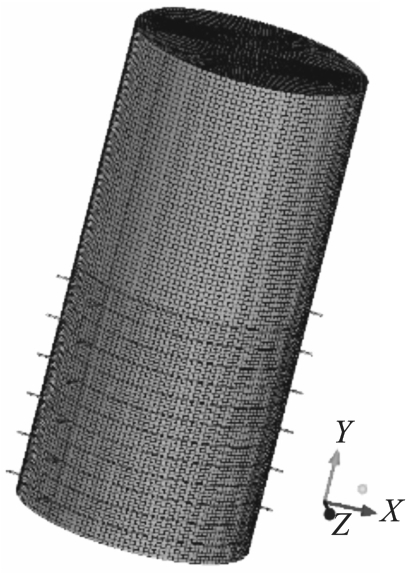
Fig.2 Schematic diagram of grid division for cyclone furnace

Fig.3 Carbon dioxide gas velocity at Y=4 m on Z=0 m longitudinal section of cyclone furnace with different grid numbers
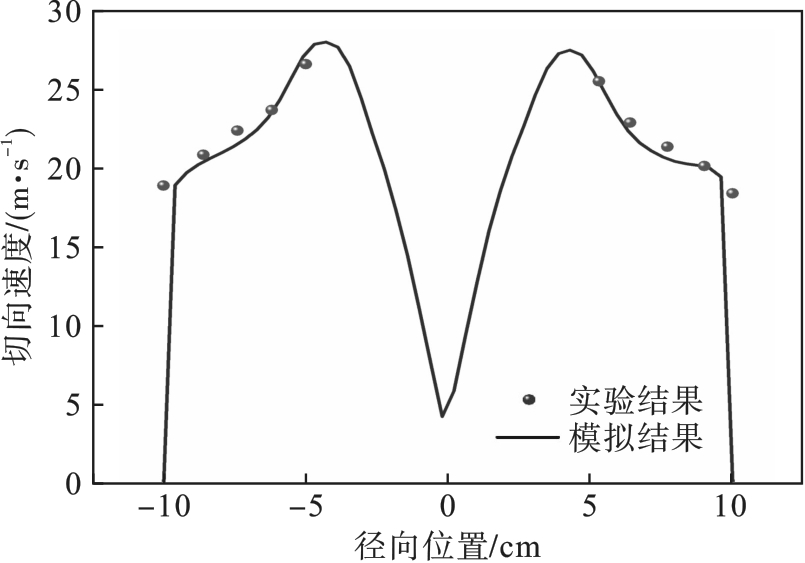
Fig.4 Tangential velocity at Z=-0.2 m on Y=0 m longitudinal section of cyclone separator
| 算例 | |||
|---|---|---|---|
| Case 1 | 4 | 30 | 30 |
| Case 2 | 6 | 30 | 30 |
| Case 3 | 8 | 30 | 30 |
| Case 4 | 8 | 30 | 100 |
| Case 5 | 8 | 30 | 300 |
Table 2 Main operating parameters of different
| 算例 | |||
|---|---|---|---|
| Case 1 | 4 | 30 | 30 |
| Case 2 | 6 | 30 | 30 |
| Case 3 | 8 | 30 | 30 |
| Case 4 | 8 | 30 | 100 |
| Case 5 | 8 | 30 | 300 |
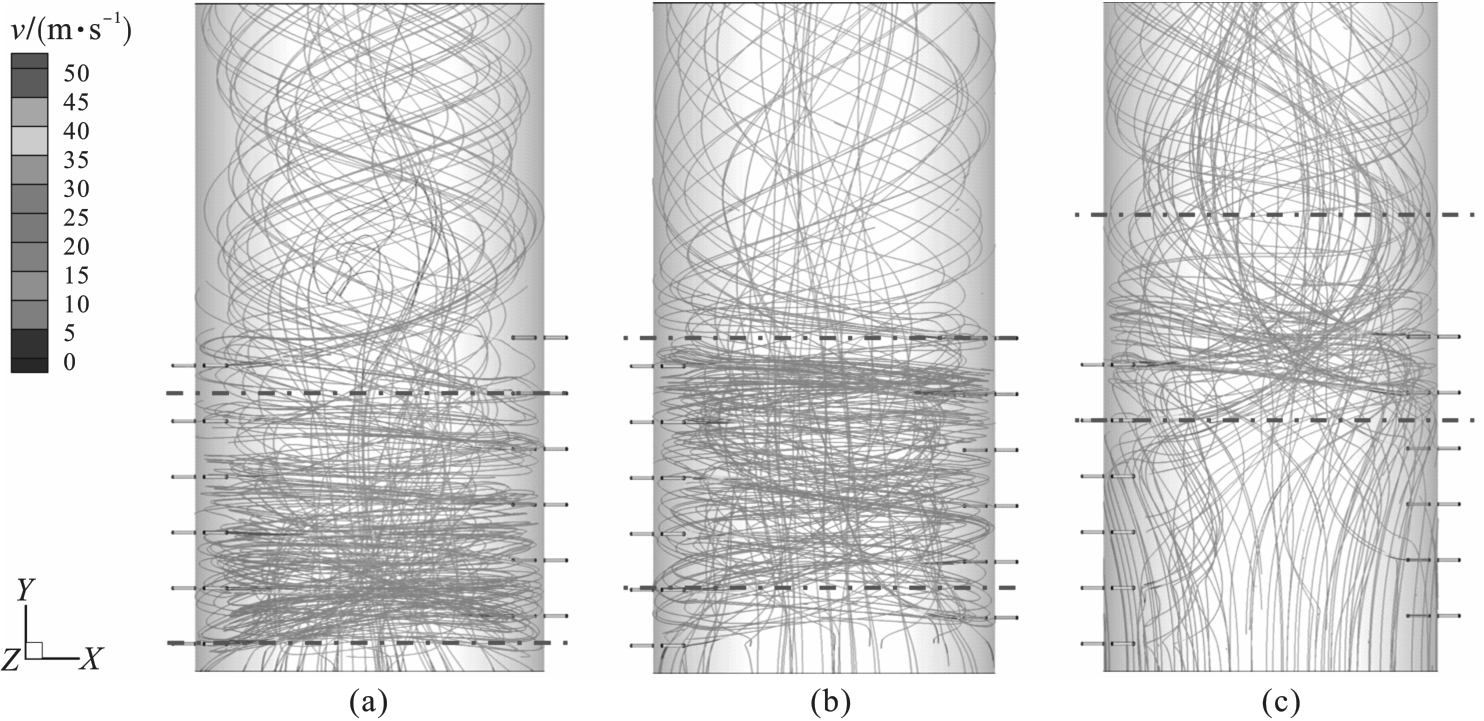
Fig.5 Gas streamline diagram of cyclone furnace
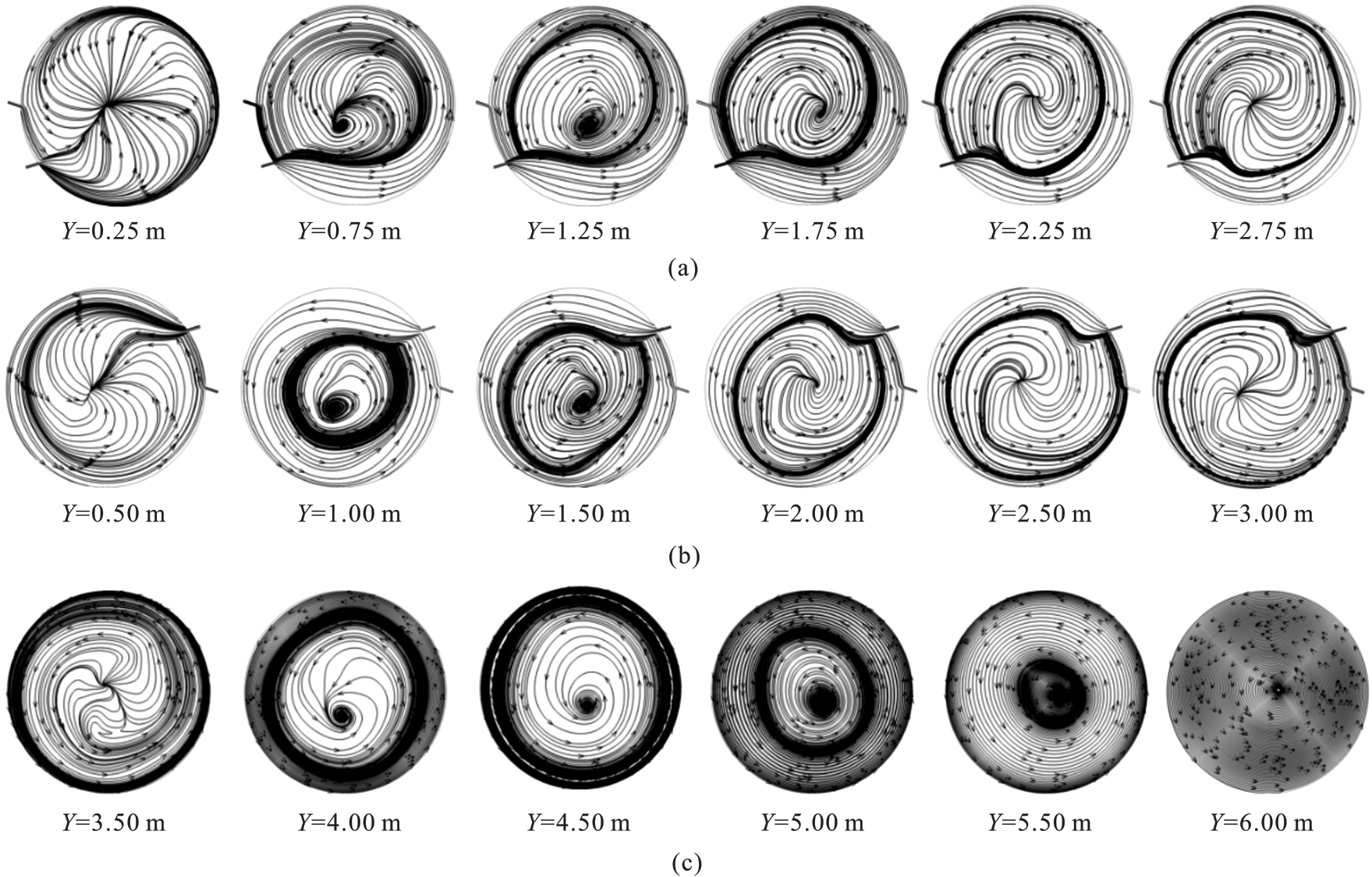
Fig.6 Gas streamline diagram at different heights when rising gas velocity is 4 m/s
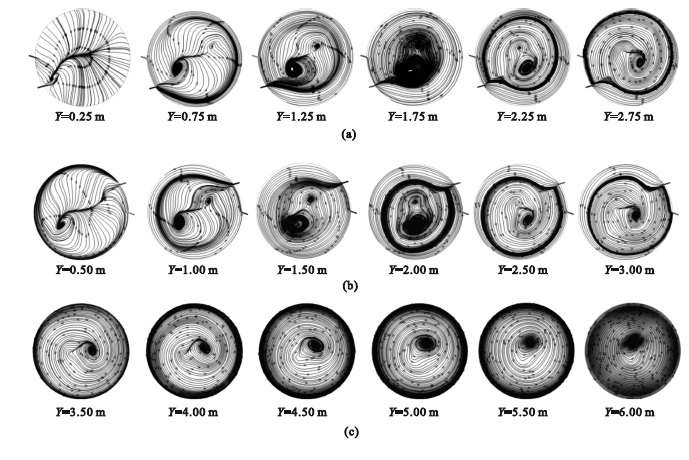
Fig.7 Gas streamline diagram at different heights when rising gas velocity is 6 m/s
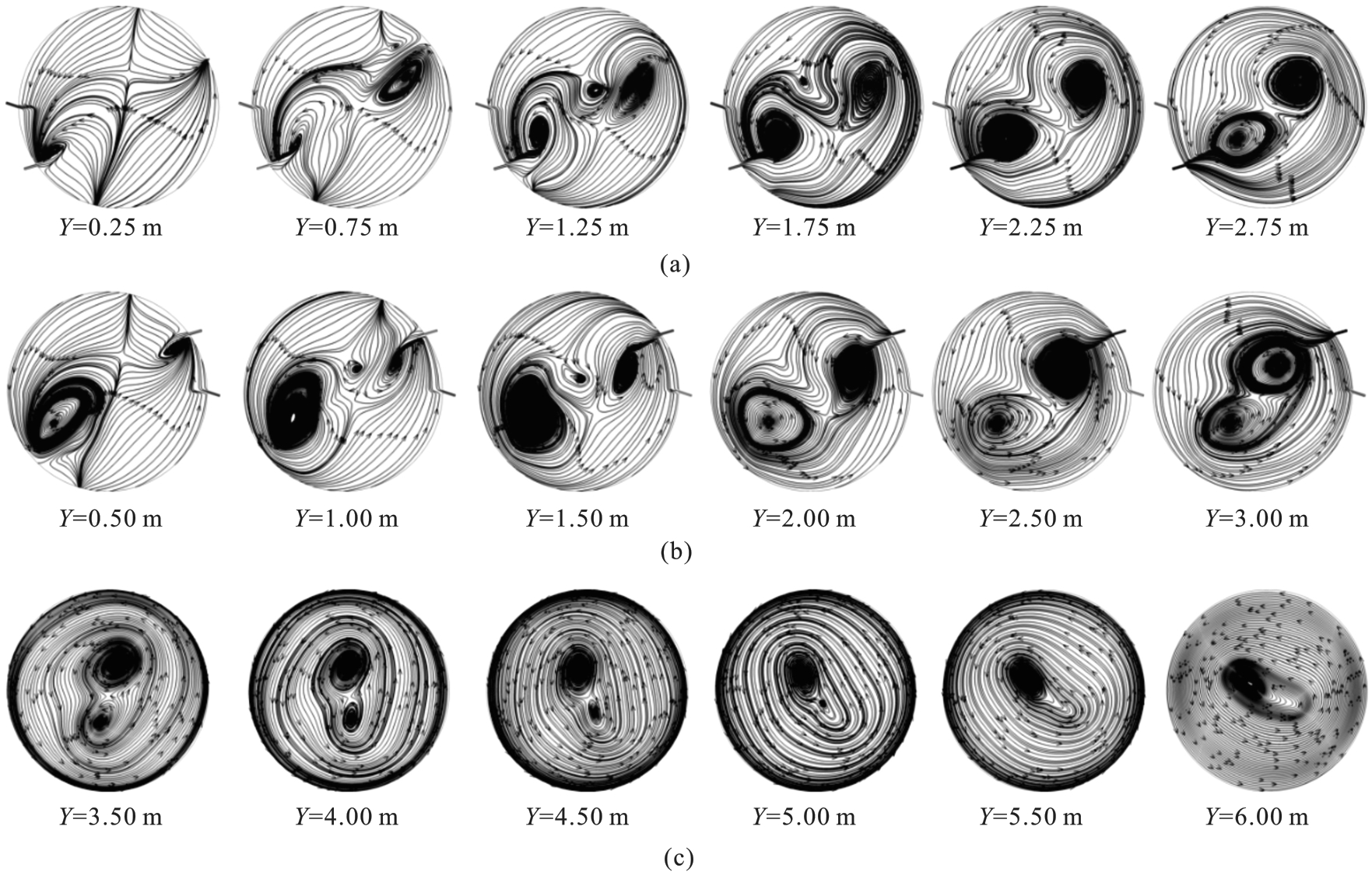
Fig.8 Gas streamline diagram at different heights when rising gas velocity is 8 m/s
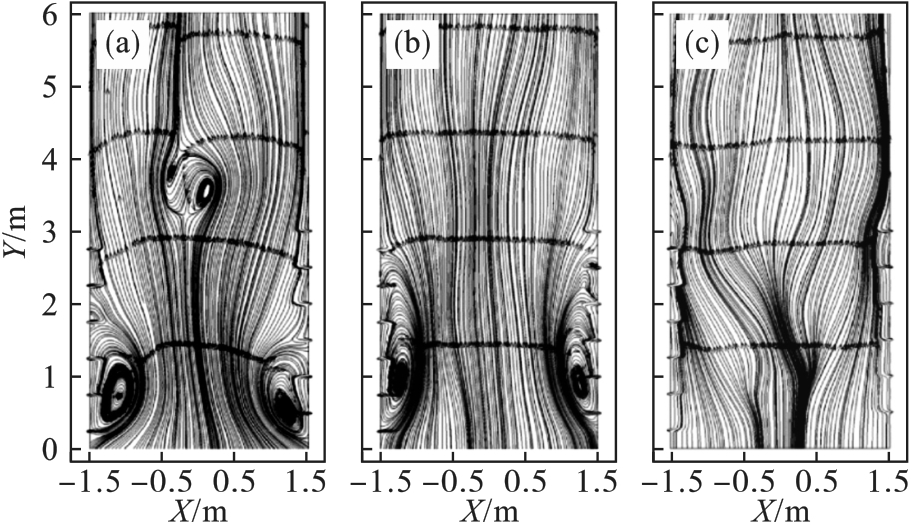
Fig.9 Gas streamline diagram of cyclone furnace in longitudinal section at Z=0 m
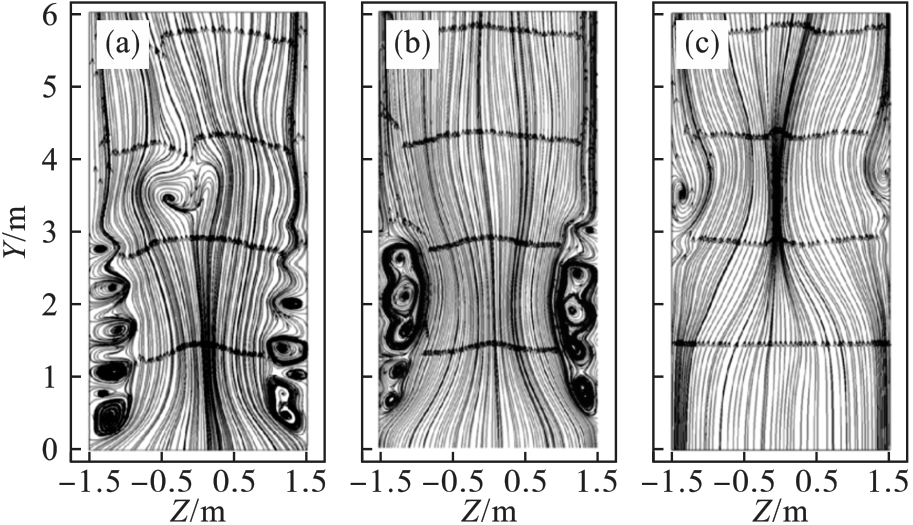
Fig.10 Gas streamline diagram of cyclone furnace in longitudinal section at X=0 m

Fig.11 Distribution of tangential velocity at different cross-sectional radial positions when rising gas velocity is 4 m/s
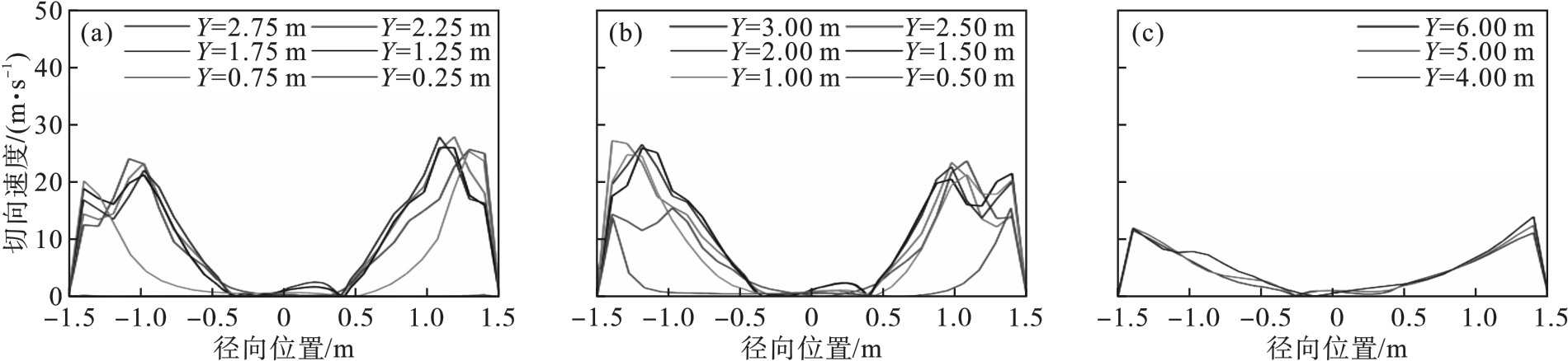
Fig.12 Distribution of tangential velocity at different cross-sectional radial positions when rising gas velocity is 6 m/s

Fig.13 Distribution of tangential velocity at different cross-sectional radial positions when rising gas velocity is 8 m/s
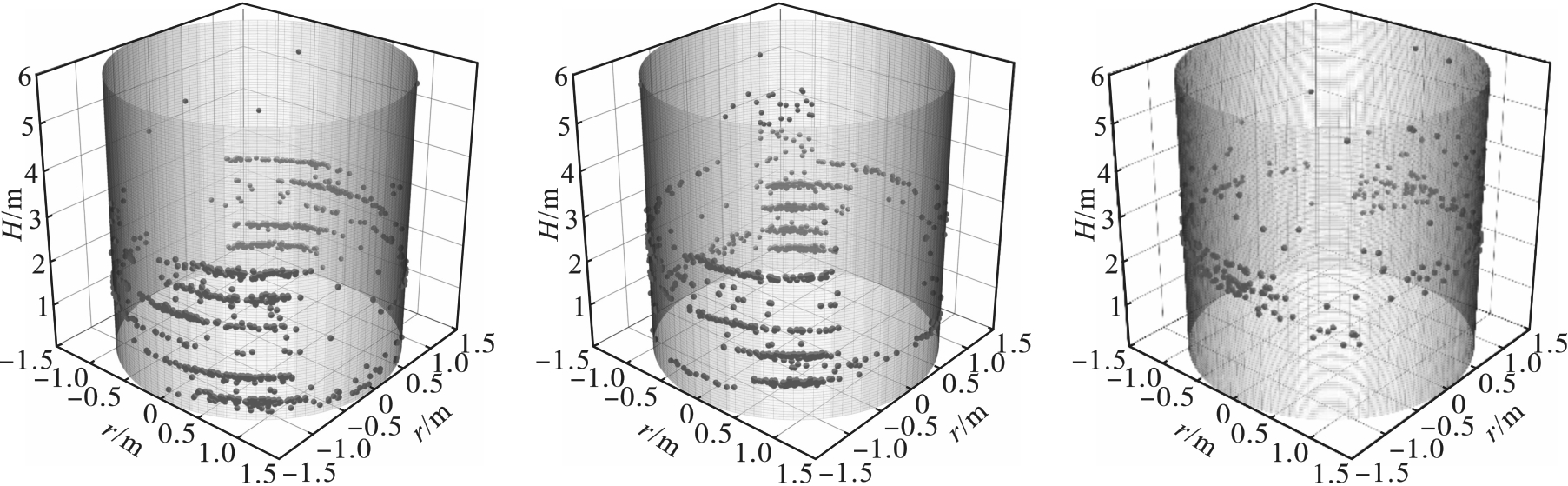
Fig.14 Scattering diagram of captured particles on wall of cyclone furnace
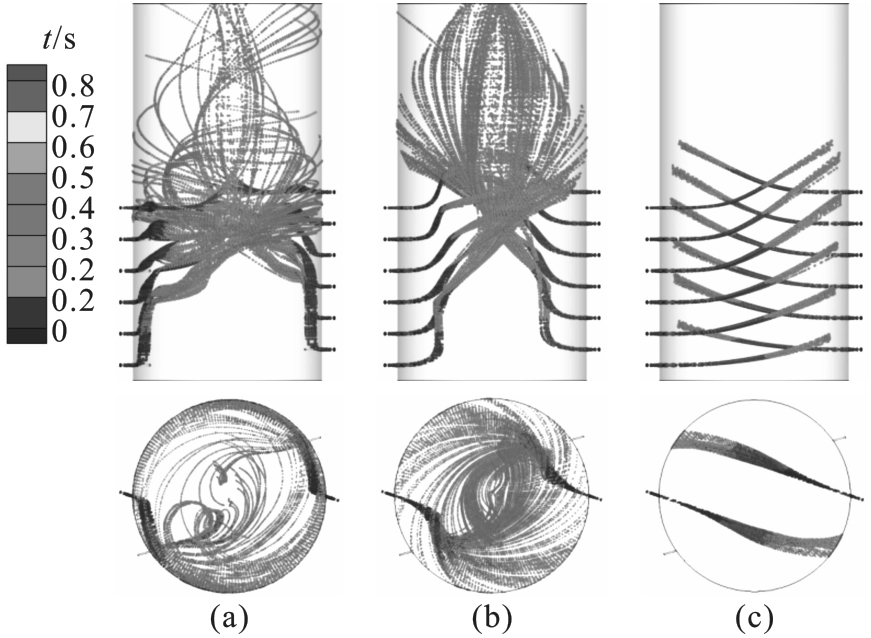
Fig.15 Motion trajectory of particles with different sizes in cyclone furnace
| [1] | 何桂珍,都兴红,曲赫威,等. 非高炉冶炼技术的发展现状与展望[J]. 矿产综合利用,2014, 35(3):1-7. |
| He Gui-zhen, Dou Xing-hong, Qu He-wei, et al. Present status and development perspective of non-blast furnace ironmaking technology[J]. Multipurpose Utilization of Mineral Resources, 2014, 35(3): 1-7. | |
| [2] | 张晓华, 师学峰, 赵凯, 等. 非高炉炼铁工艺流程发展现状及前景展望[J]. 矿产综合利用, 2020(2): 8-15. |
| Zhang Xiao-hua, Shi Xue-feng, Zhao Kai, et al. Development status and prospect of smelting reduction ironmaking process[J]. Multipurpose Utilization of Mineral Resources, 2020(2): 8-15. | |
| [3] | 张福君,杨树峰,李京社,等. “双碳”背景下低碳排炼钢流程选择及关键技术[J]. 工程科学学报, 2022, 44(9):1483-1495. |
| Zhang Fu-jun, Yang Shu-feng, Li Jing-she,et al. Selection and key technologies of low-carbon steelmaking processes under the background of “double carbon”[J]. Chinese Journal of Engineering,2022,44(9):1483-1495. | |
| [4] | 崔志峰,徐安军,上官方钦. 国内外钢铁行业低碳发展策略分析[J]. 工程科学学报,2022, 44(9):1496-1506. |
| Cui Zhi-feng, Xu An-jun, Shangguan Fang-qin. Low-carbon development strategy analysis of the domestic and foreign steel industry[J]. Chinese Journal of Engineering, 2022, 44(9): 1496-1506. | |
| [5] | Quader M A, Ahmed S, Dawal S Z,et al. Present needs,recent progress and future trends of energy-efficient ultra-low carbon dioxide (CO2) steelmaking (ULCOS) program[J]. Renewable&Sustainable Energy Reviews,2016, 55:537-549. |
| [6] | 严珺洁. 超低二氧化碳排炼钢项目的进展与未来[J]. 中国冶金,2017, 27(2):6-11. |
| Yan Jun-jie. Progress and future of uItra-low carbon dioxide emision steelmaking project[J]. China Metallurgical, 2017, 27(2): 6-11. | |
| [7] | Sripriya R, Peeters T, Meijer K, et al. Computational fluid dynamics and combustion modelling of HIsarna incinerator[J]. Ironmaking&Steelmaking, 2016, 43(3): 192-202. |
| [8] | Schrama F N H, Beunder E M, J W K van Boggelen, et al. Desulphurisation of HIsarna hot metal-a comparison study based on plant data[C]//3rd International Conference on Science and Technology of Ironmaking & Steelmaking. Kanpur,2017: 419-422. |
| [9] | Van Boggelen J W K, Meijer H K A, Zeilstra C, et al. HIsarna-demonstrating low CO2 ironmaking at pilot scale[J]. Steel VIA, 2018: 25-27. |
| [10] | Meijer H K A, Laar J, Knoop D W, et al. 旋流转换炉(CCF)装置的工艺设计[J]. 燃料与化工,1998(5):277-281. |
| Meijer H K A, Laar J, Knoop D W, et al. Process design of cyclone converter furnace (CCF) device[J]. Fuel & Chemical Processes, 1998(5): 277-281. | |
| [11] | Cao C, Meng Y, Mei C, et al. Latest progress in industrialization of HIsmelt process[C]//11th Iron and Steel Conference of China Proceedings.Beijing, 2017: 1-7. |
| [12] | Khasraw D, Spooner S, Hage H, et al. Evaluation of devolatilization behaviour of different carbonaceous materials under rapid heating for the novel HIsarna ironmaking process[J]. Fuel, 2021, 292: 120329. |
| [13] | Khasraw D, Htet T T, Yang X L, et al. Gasification and structural behaviour of different carbon sources and resultant chars from rapid devolatilization for HIsarna alternative ironmaking process[J]. Fuel, 2022, 309: 122210. |
| [14] | Denys M B. Dynamical modelling of the cyclone converter furnace[D]. Delft: Delft University of Technology, 1997. |
| [15] | Link J. IRMA-flowsheet model examples of application[J]. Metallurgical Research & Technology, 2009, 106(10): 398-403. |
| [16] | Chaghakaboodi H A, Saidi M. Numerical study of gas-solid flow in a square cyclone separator with different vortex finders[J]. Chemical Engineering Research&Design, 2023, 194: 621-635. |
| [17] | Venkatesh S, Sivapirakasam S P, Sakthivel M, et al. Experimental and numerical investigation in the series arrangement square cyclone separator[J]. Powder Technology, 2021, 383: 93-103. |
| [18] | 林秀丽, 曹亚平, 夏祉君, 等. 轴流旋风分离器特性的数值模拟[J]. 东北大学学报(自然科学版), 2019, 40(9): 1360-1364. |
| Lin Xiu-li, Cao Ya-ping, Xia Zhi-jun, et al. Numerical simulation on characteristics of the axial flow cyclone separator[J]. Journal of Northeastern University (Natural Science), 2019, 40(9): 1360-1364. | |
| [19] | Wasilewski M, Brar L S, Ligus G. Effect of the central rod dimensions on the performance of cyclone separators-optimization study[J]. Separation&Purification Technology, 2021, 274: 119020. |
| [20] | Zhu L, Wang S, Ru Y, et al. Numerical investigation on dynamic characteristics of flow field in cyclone separators with different dust hopper structures[J]. Particuology, 2023, 82: 134-145. |
| [21] | Dong S J, Jiang Y C, Jin R Z, et al. Numerical study of vortex eccentricity in a gas cyclone[J]. Applied Mathematical Modelling, 2020, 80: 683-701. |
| [22] | Dong S J, Wang C W, Zhang Z H, et al. Numerical study of short-circuiting flow and particles in a gas cyclone[J]. Particuology, 2023, 72: 81-93. |
| [23] | Parvaz F, Hosseini S H, Elsayed K, et al. Influence of the dipleg shape on the performance of gas cyclones[J]. Separation&Purification Technology, 2020, 223: 116000. |
| [24] | Dziubak T, Bąkała L, Karczewski M, et al. Numerical research on vortex tube separator for special vehicle engine inlet air filter[J]. Separation&Purification Technology, 2020, 239: 116588. |
| [25] | Pang X X, Wang C Y, Yang W, et al. Numerical simulation of a cyclone separator to recycle the active components of waste lithium batteries[J].Engineering Applications of Computational Fluid Mechanics, 2022, 16(1): 937-951. |
| [26] | Zhang Z H, Dong S J, Jin R Z, et al. Vortex characteristics of a gas cyclone determined with different vortex identification methods[J]. Powder Technology, 2022, 404: 117370. |
| [27] | Liu G H, Wang W B, Yu J Z, et al. Effect of extra inlets structure on cyclone wall erosion[J]. Powder Technology, 2022, 411: 117926. |
| [28] | Zhang L L, Chen Y X, Zhao B, et al. Numerical simulation on structure optimization of escape-pipe of cyclone separator with downward outlet [J]. Powder Technology, 2022, 411: 117588. |
| [29] | 王晨雯. 旋风分离器内短路流的流动特征与形成机理研究[D]. 兰州:兰州大学,2020. |
| Wang Chen-wen. Study on flow characteristics and formation mechanism of short-circuit flow in cyclone separator[D]. Lanzhou: Lanzhou University, 2020. | |
| [30] | Zhang Z H, Yan S J, Dong S J, et al. Study of the short-circuit flow and circulation flow’s impact on separation performance of cyclone separator with volute-helical inlet[J]. Advanced Powder Technology, 2024, 35(1): 104281. |
| [1] | XIN Bo, CHENG Guang, YAO Jun, GONG Ya-dong. Powder Mixing Mechanism of Laser Cladding Forming for Adaptive FGM [J]. Journal of Northeastern University Natural Science, 2020, 41(8): 1123-1128. |
| [2] | LIN Xiu-li, CAO Ya-ping, XIA Zhi-jun, LIU Jing-xian. Numerical Simulation on Characteristics of the Axial Flow Cyclone Separator [J]. Journal of Northeastern University Natural Science, 2019, 40(9): 1360-1364. |
| [3] | CHEN Ju-shi, JIANG Zhong-an, ZHANG Yi-kun. Experimental Study on Dust Concentration Distribution in Crushing Chamber [J]. Journal of Northeastern University Natural Science, 2015, 36(7): 1051-1055. |
| [4] | WU Keng, WANG Meng, ZHAO Yong, WANG Chongmao. A New Method for the Measuration of Assimilation Characteristics of Iron Ore Powder [J]. Journal of Northeastern University, 2013, 34(7): 961-965. |
| Viewed | ||||||
|
Full text |
|
|||||
|
Abstract |
|
|||||
