
Journal of Northeastern University(Natural Science) ›› 2025, Vol. 46 ›› Issue (9): 58-64.DOI: 10.12068/j.issn.1005-3026.2025.20240040
• Materials & Metallurgy • Previous Articles Next Articles
Zi-jian GE1,2, Zhi YI1,2( ), Guo-jun LI1,2, Lin-yang WEI1,2
Received:2024-03-04
Online:2025-09-15
Published:2025-12-03
Contact:
Zhi YI
CLC Number:
Zi-jian GE, Zhi YI, Guo-jun LI, Lin-yang WEI. Monte Carlo Method for Solving Two-Dimensional Coupled Anisotropic Conduction-Radiation Heat Transfer[J]. Journal of Northeastern University(Natural Science), 2025, 46(9): 58-64.

Fig.1 Two-dimensional discrete node model
| PW | PS | PE | PN | PNE | Qds |
|---|---|---|---|---|---|
Table 1 Coefficients of nodal discrete equation
| PW | PS | PE | PN | PNE | Qds |
|---|---|---|---|---|---|

Fig.2 Geometric model of random walk

Fig.3 Flowchart of random movement of coupled proton
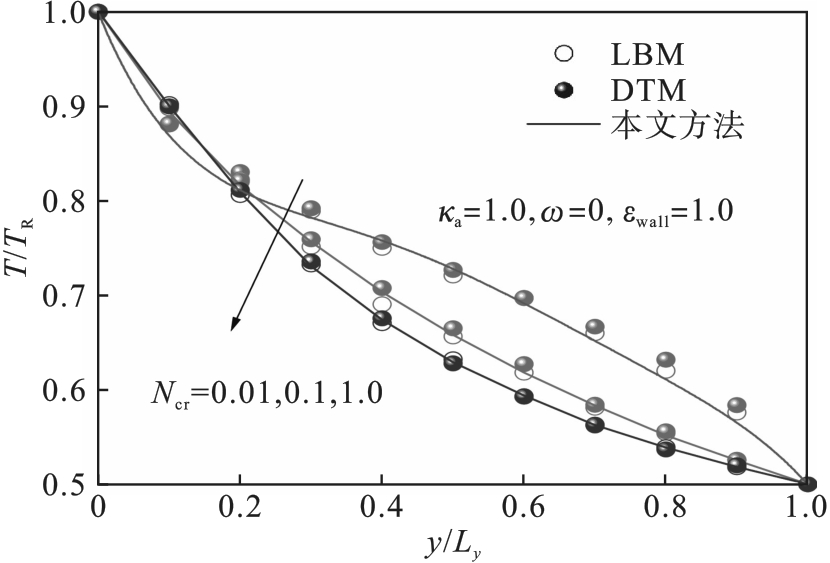
Fig.4 Temperature distribution curves along y-direction at x/Lx =0.5
| Ncr | y/Ly | T/TR | ||
|---|---|---|---|---|
| DTM | LBM | 本文方法 | ||
| 0.3 | 0.737 | 0.738 | 0.736 | |
| 1.0 | 0.5 | 0.630 | 0.631 | 0.630 |
| 0.7 | 0.567 | 0.564 | 0.564 | |
| 0.3 | 0.760 | 0.759 | 0.758 | |
| 0.1 | 0.5 | 0.663 | 0.662 | 0.662 |
| 0.7 | 0.594 | 0.593 | 0.593 | |
| 0.3 | 0.790 | 0.788 | 0.785 | |
| 0.01 | 0.5 | 0.725 | 0.722 | 0.726 |
| 0.7 | 0.665 | 0.662 | 0.653 | |
Table 2 Dimensionless temperature T/TR at aspecific location on centerline(x/Lx=0.5,y/Ly) for different conduction-radiation parameter Ncr
| Ncr | y/Ly | T/TR | ||
|---|---|---|---|---|
| DTM | LBM | 本文方法 | ||
| 0.3 | 0.737 | 0.738 | 0.736 | |
| 1.0 | 0.5 | 0.630 | 0.631 | 0.630 |
| 0.7 | 0.567 | 0.564 | 0.564 | |
| 0.3 | 0.760 | 0.759 | 0.758 | |
| 0.1 | 0.5 | 0.663 | 0.662 | 0.662 |
| 0.7 | 0.594 | 0.593 | 0.593 | |
| 0.3 | 0.790 | 0.788 | 0.785 | |
| 0.01 | 0.5 | 0.725 | 0.722 | 0.726 |
| 0.7 | 0.665 | 0.662 | 0.653 | |

Fig.5 Dimensionless temperature distribution curves along y-direction at x/Lx =0.5
| 计算条件 | ||
|---|---|---|
| 1 | 0.25 | 0.5 |
| 2 | 0.25 | 1.5 |
| 3 | 0.50 | 1.0 |
| 4 | 0.50 | 1.5 |
Table 3 Calculation conditions
| 计算条件 | ||
|---|---|---|
| 1 | 0.25 | 0.5 |
| 2 | 0.25 | 1.5 |
| 3 | 0.50 | 1.0 |
| 4 | 0.50 | 1.5 |

Fig.6 Dimensionless temperature cloud map of plate
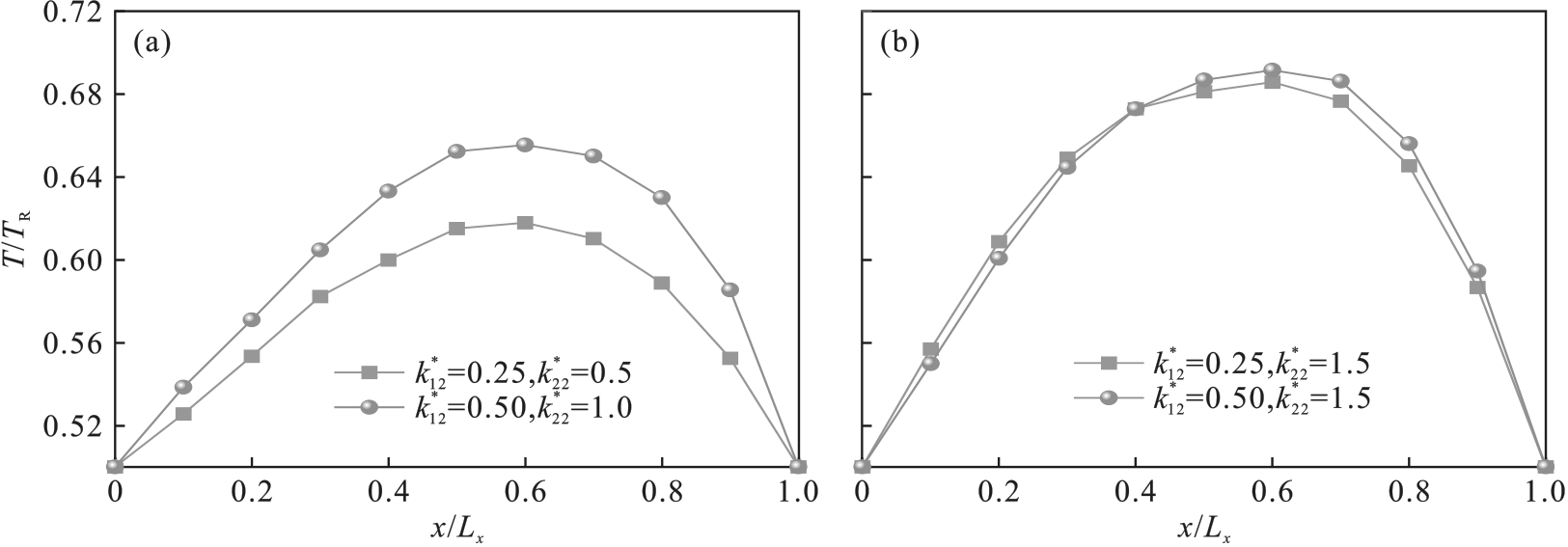
Fig.7 Dimensionless temperature distribution curves along x-direction at y/Ly =0.5
| [1] | Ge W A, Zhao C Y, Wang B X. Thermal radiation and conduction in functionally graded thermal barrier coatings. Part I: experimental study on radiative properties[J]. International Journal of Heat and Mass Transfer, 2019, 134: 101-113. |
| [2] | Ge W A, Zhao C Y, Wang B X. Thermal radiation and conduction in functionally graded thermal barrier coatings. Part Ⅱ: experimental thermal conductivities and heat transfer modeling[J]. International Journal of Heat and Mass Transfer, 2019, 134: 166-174. |
| [3] | Wellele O, Orlande H R B, Ruperti J N, et al. Coupled conduction-radiation in semi-transparent materials at high temperatures[J]. Journal of Physics and Chemistry of Solids, 2006, 67 (9/10):2230-2240. |
| [4] | Yi Z, Su Z G, Li G J, et al. Development of a double model slab tracking control system for the continuous reheating furnace[J]. International Journal of Heat and Mass Transfer, 2017, 113: 861-874. |
| [5] | Liu D L, Chen H L. Numerical verification of a nonlocal discrete model for anisotropic heat conduction problems[J]. International Journal of Thermal Sciences, 2023, 191: 108360. |
| [6] | Norouzi M, Rahmani H. An exact analysis for transient anisotropic heat conduction in truncated composite conical shells[J]. Applied Thermal Engineering, 2017, 124:422-431. |
| [7] | Mishra S C, Talukdar P, Trimis D, et al. Computational efficiency improvements of the radiative transfer problems with or without conduction: a comparison of the collapsed dimension method and the discrete transfer method[J]. International Journal of Heat and Mass Transfer, 2003, 46(16): 3083-3095. |
| [8] | Mishra S C, Roy H K. Solving transient conduction and radiation heat transfer problems using the lattice Boltzmann method and the finite volume method[J]. Journal of Computational Physics, 2007, 223(1):89-107. |
| [9] | Ma J, Sun Y S, Li B W, et al. Spectral collocation method for radiative-conductive porous fin with temperature dependent properties[J]. Energy Conversion and Management, 2016, 111: 279-288. |
| [10] | Ma J, Sun Y S, Li B W. Spectral collocation method for transient thermal analysis of coupled conductive, convective and radiative heat transfer in the moving plate with temperature dependent properties and heat generation[J]. International Journal of Heat and Mass Transfer, 2017, 114: 469-482. |
| [11] | Sun Y J, Zhang X B, Howell J R. Non-gray combined conduction and radiation heat transfer by using FVM and SLW[J]. Journal of Quantitative Spectroscopy and Radiative Transfer, 2017, 197: 51-59. |
| [12] | Wei Y J, Liu X C, Zhu K Y, et al. A unified lattice Boltzmann framework for combined radiation-conduction heat transfer[J]. International Journal of Heat and Mass Transfer, 2023, 200: 123513. |
| [13] | Sun Y S, Li X Y, Zhao J Z, et al. Investigation of transient coupled conduction and radiation heat transfer in the linearly anisotropic scattering cylindrical medium by spectral collocation method[J]. International Journal of Thermal Sciences, 2022, 172: 107308. |
| [14] | Modest M F. Radiative heat transfer [M]. Cambridge: Academic Press, 2003:644-679. |
| [15] | Howell J R, Perlmutter M. Monte Carlo solution of thermal transfer through radiant media between gray walls[J]. Journal of Heat Transfer, 1964, 86(1): 116-122. |
| [16] | Li G J, Zhong J Q, Wang X D. An improved Monte Carlo method for radiative heat transfer in participating media[J]. Journal of Quantitative Spectroscopy and Radiative Transfer, 2020, 251: 107081. |
| [17] | Li D Y, Li G J, Hong D L, et al. Improved Monte Carlo method for radiative heat transfer in semitransparent media with BRDF surface[J]. International Journal of Thermal Sciences, 2023, 187: 108152. |
| [18] | Wong B T, Pinar-Mengüç M. A unified Monte Carlo treatment of the transport of electromagnetic energy, electrons, and phonons in absorbing and scattering media[J]. Journal of Quantitative Spectroscopy and Radiative Transfer, 2010, 111(3): 399-419. |
| [19] | Haji-Sheikh A, Sparrow E M. The solution of heat conduction problems by probability methods[J]. Journal of Heat Transfer, 1967, 89(2): 121-130. |
| [20] | Kowsary F, Arabi M.Monte Carlo solution of anisotropic heat conduction[J]. International Communications in Heat and Mass Transfer, 1999, 26(8):1163-1173. |
| [21] | Kowsary F, Irano S. Monte Carlo solution of transient heat conduction in anisotropic media[J]. Journal of Thermophysics and Heat Transfer, 2006, 20(2): 342-346. |
| [22] | Naeimi H, Kowsary F. Finite volume Monte Carlo (FVMC) method for the analysis of conduction heat transfer[J]. Journal of the Brazilian Society of Mechanical Sciences and Engineering, 2019, 41(6): 260. |
| [23] | 谈和平, 夏新林, 刘林华, 等. 红外辐射特性与传输的数值计算: 计算热辐射学[M]. 哈尔滨: 哈尔滨工业大学出版社, 2006: 157-173. |
| Tan He-ping, Xia Xin-lin, Liu Lin-hua, et al. Numerical calculation of infrared radiation characteristics and transmission: computational thermal radiation[M]. Harbin: Harbin Institute of Technology Press, 2006: 157-173. |
| [1] | QIAO Li-ping, LU Wei-li, MIN Zhong-shun, WANG Zhe-chao. Reliability Analysis of Rock Block Stability and Support for Underground Water-Sealed Storage Caverns [J]. Journal of Northeastern University(Natural Science), 2023, 44(4): 544-550. |
| [2] | YANG Bo-wen, HUO Jun-zhou, ZHANG Wei, ZHANG Zhan-ge. Research on Real-Time Overload Prediction Method of in-Service Structures [J]. Journal of Northeastern University(Natural Science), 2022, 43(4): 541-550. |
| [3] | CAO Ru-nan, SUN Zhi-li, GUO Fan-yi, WANG Jian. Time-Dependent Reliability Algorithm Based on Kriging and Monte Carlo [J]. Journal of Northeastern University(Natural Science), 2021, 42(5): 658-664. |
| [4] | KANG Yu-mei, LI Jia-qi, LIU Zi-ao, YU Jia-yue. Reliability Study of Prefabricated Box Culvert Components Based on Probability Density Evolution Method [J]. Journal of Northeastern University(Natural Science), 2021, 42(12): 1782-1789. |
| [5] | YU Zhen-liang, SUN Zhi-li, ZHANG Yi-bo, WANG Jian. A Structural Reliability Analysis Method Based on Adaptive PC-Kriging Model [J]. Journal of Northeastern University Natural Science, 2020, 41(5): 667-672. |
| [6] | QI Feng-sheng, WANG Zi-song, LI Bao-kuan. Slab Heating Uniformity Based on Multi-field Coupling Heat Transfer in Reheating Furnace [J]. Journal of Northeastern University Natural Science, 2019, 40(10): 1413-1418. |
| [7] | MA Liang, XIAO Ping, WANG Ren-sheng, XIU Shi-chao. An Isolated Chain Rheological Shear Stress Model with Distance Weighted Coefficients [J]. Journal of Northeastern University Natural Science, 2018, 39(2): 226-231. |
| [8] | LIU Kuo, LI Xiao-lei, WANG Jian. An Analysis Method of Mechanical Structural Reliability Based on the Kriging Model [J]. Journal of Northeastern University Natural Science, 2017, 38(7): 1002-1006. |
| [9] | LIU Jie, ZHAO Xing-dong, WEN Xin-liang. Numerical Simulation on the Anisotropy Seepage Characteristic of Water-Sealed Underground Oil Storage Caverns [J]. Journal of Northeastern University Natural Science, 2015, 36(11): 1638-1642. |
| [10] | WANG Pei-tao , YANG Tian-hong, YU Qing-lei, SHI Wen-hao. Uniaxial Compression Test and Numerical Simulation of Stratified Biotite Granulite [J]. Journal of Northeastern University Natural Science, 2015, 36(11): 1633-1637. |
| [11] | WU Ying-hui, TANG Jia-fu , GONG Jun. Optimization Model for Single Bus Route Schedule Design Problem with Stochastic Travel Time [J]. Journal of Northeastern University:Natural Science, 2015, 36(10): 1393-1398. |
| [12] | YANG Yanlin, BU Fanting, WANG Fugang, XU Tianfu. Effect of Anisotropy on CO2Water Two Phase Fluid Migration—Function Improvement of the TOUGH2 Simulator [J]. Journal of Northeastern University Natural Science, 2014, 35(8): 1211-1215. |
| [13] | MA Yuanyuan, XIE Liyang, LIN Wenqiang. Random Load History of Hydraulic Support and Application of Monte Carlo Method [J]. Journal of Northeastern University Natural Science, 2014, 35(1): 93-96. |
| Viewed | ||||||
|
Full text |
|
|||||
|
Abstract |
|
|||||
