
Journal of Northeastern University(Natural Science) ›› 2026, Vol. 47 ›› Issue (1): 42-51.DOI: 10.12068/j.issn.1005-3026.2026.20250067
• Smart Healthcare Column • Previous Articles Next Articles
Lin QI1,2,3, Qi-he GAO1, Shu-yue GUAN1, Yong-chun LI4( )
)
Received:2025-06-12
Online:2026-01-15
Published:2026-03-17
Contact:
Yong-chun LI
CLC Number:
Lin QI, Qi-he GAO, Shu-yue GUAN, Yong-chun LI. Non-contact Estimation Method of Blood Oxygen Saturation Based on Facial Videos[J]. Journal of Northeastern University(Natural Science), 2026, 47(1): 42-51.
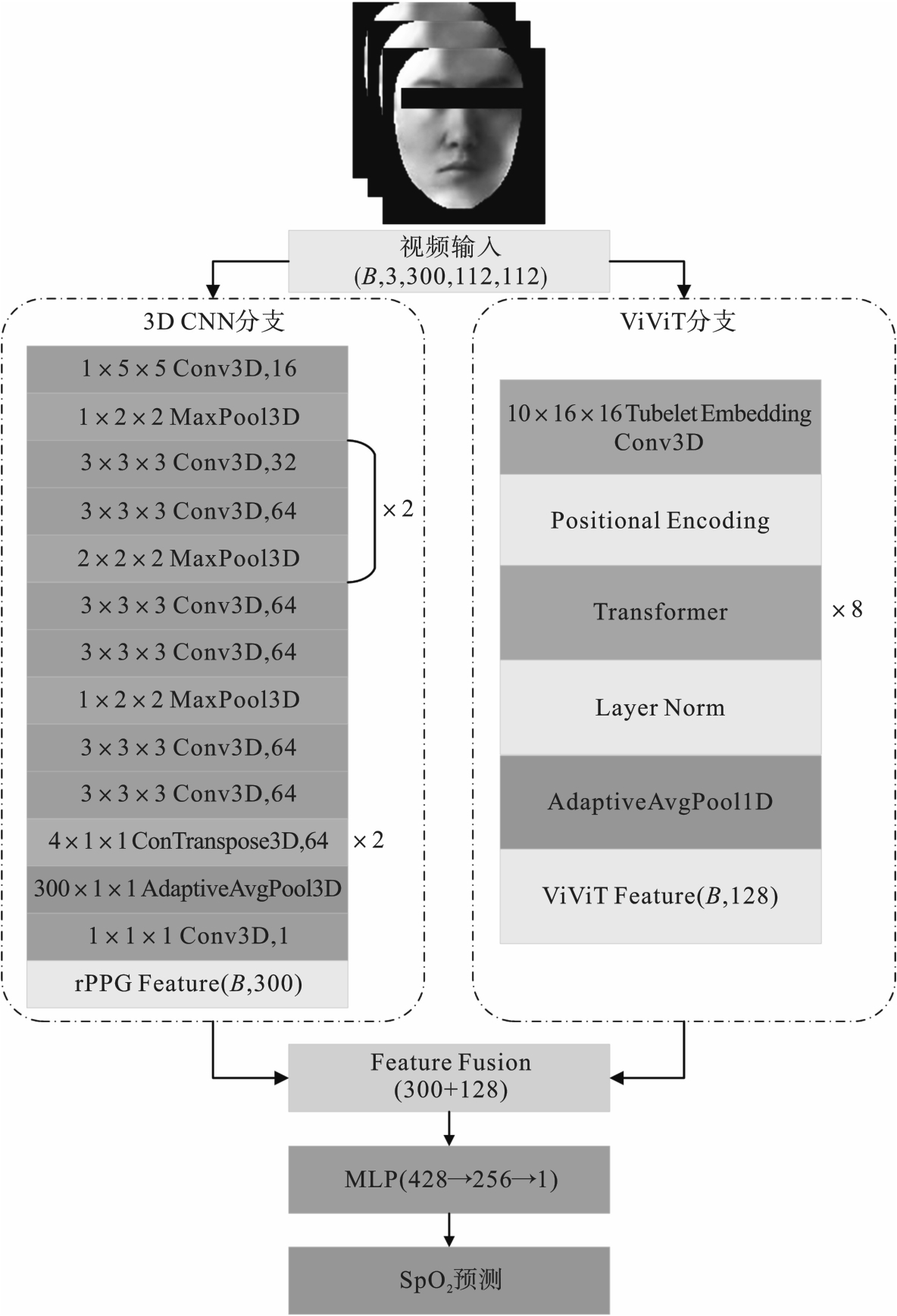
Fig.1 Architecture of TAST-Net
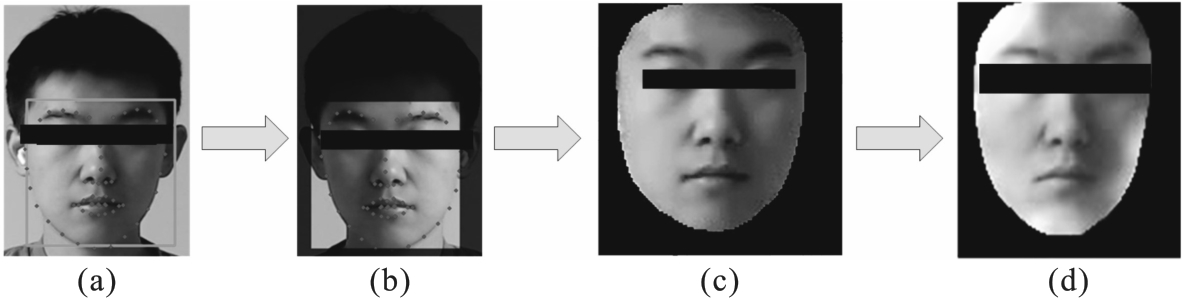
Fig.2 Data preprocessing process
| 模型 | R | 参数量/106 | 推理速度/(ms·帧-1) | ||
|---|---|---|---|---|---|
| 3D-CNN | 6.13 | 5.89 | 0.25 | 13.33 | 1.182 |
| MultiPhysNet | 0.91 | 0.72 | 0.86 | 0.153 | |
| ITSCAN | 1.72 | 1.36 | 0.73 | 22.48 | 0.194 |
| MMFM | 0.74 | 0.077 | |||
| Our TAST-Net | 0.53 | 0.37 | 0.96 | 3.24 |
Table 1 Blood oxygen saturation estimation results of different models on PURE dataset
| 模型 | R | 参数量/106 | 推理速度/(ms·帧-1) | ||
|---|---|---|---|---|---|
| 3D-CNN | 6.13 | 5.89 | 0.25 | 13.33 | 1.182 |
| MultiPhysNet | 0.91 | 0.72 | 0.86 | 0.153 | |
| ITSCAN | 1.72 | 1.36 | 0.73 | 22.48 | 0.194 |
| MMFM | 0.74 | 0.077 | |||
| Our TAST-Net | 0.53 | 0.37 | 0.96 | 3.24 |
| 模型 | R | 参数量/106 | 推理速度/(ms·帧-1) | ||
|---|---|---|---|---|---|
| 3D-CNN | 2.62 | 2.42 | 0.63 | 13.33 | 1.182 |
| MultiPhysNet | 0.153 | ||||
| ITSCAN | 1.14 | 0.72 | 0.70 | 22.48 | 0.194 |
| MMFM | 1.16 | 0.87 | 0.59 | 0.74 | 0.077 |
| Our TAST-Net | 0.84 | 0.57 | 0.82 | 3.24 |
Table 2 Blood oxygen saturation estimation results of different models on VIPL-HR dataset
| 模型 | R | 参数量/106 | 推理速度/(ms·帧-1) | ||
|---|---|---|---|---|---|
| 3D-CNN | 2.62 | 2.42 | 0.63 | 13.33 | 1.182 |
| MultiPhysNet | 0.153 | ||||
| ITSCAN | 1.14 | 0.72 | 0.70 | 22.48 | 0.194 |
| MMFM | 1.16 | 0.87 | 0.59 | 0.74 | 0.077 |
| Our TAST-Net | 0.84 | 0.57 | 0.82 | 3.24 |
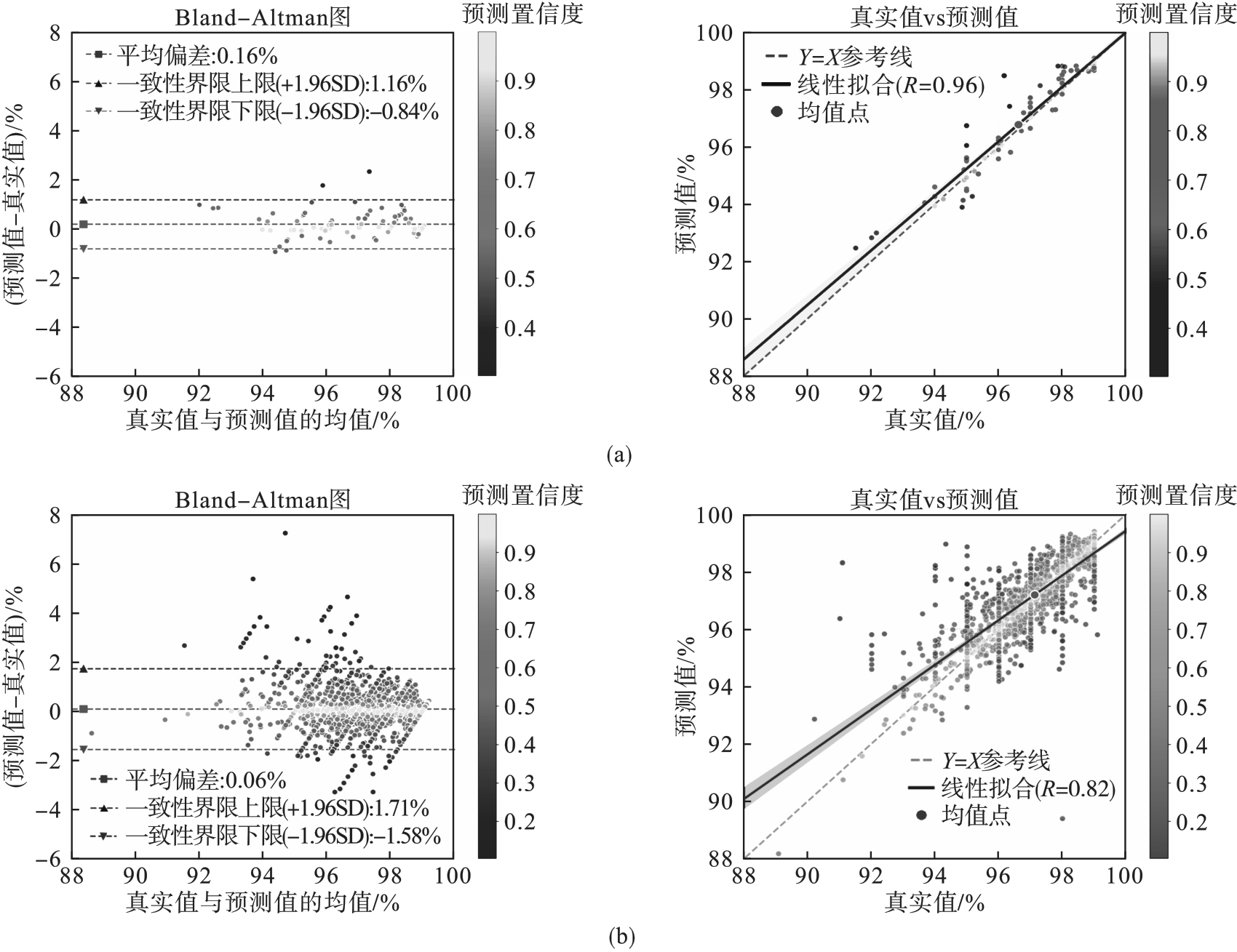
Fig.3 Visualization of blood oxygen saturation estimation results of TAST-Net on public dataset
| 模型 | R | ||
|---|---|---|---|
| Baseline | 1.32 | 1.05 | 0.68 |
| Baseline+Dual-Path Architecture | 0.58 | 0.41 | 0.95 |
| Baseline+Total Loss( | 1.12 | 0.85 | 0.84 |
| Our TAST-Net | 0.53 | 0.37 | 0.96 |
Table 3 Ablation experiment results of TAST-Net
| 模型 | R | ||
|---|---|---|---|
| Baseline | 1.32 | 1.05 | 0.68 |
| Baseline+Dual-Path Architecture | 0.58 | 0.41 | 0.95 |
| Baseline+Total Loss( | 1.12 | 0.85 | 0.84 |
| Our TAST-Net | 0.53 | 0.37 | 0.96 |
| 数据集 | 预处理方式 | R | ||
|---|---|---|---|---|
| PURE | TAST-Net(无EVM) | 0.59 | 0.46 | 0.94 |
| TAST-Net(有EVM) | 0.53 | 0.37 | 0.96 | |
| VIPL-HR | TAST-Net(无EVM) | 0.91 | 0.66 | 0.79 |
| TAST-Net(有EVM) | 0.84 | 0.57 | 0.82 |
Table 4 Ablation experiment results of EVM
| 数据集 | 预处理方式 | R | ||
|---|---|---|---|---|
| PURE | TAST-Net(无EVM) | 0.59 | 0.46 | 0.94 |
| TAST-Net(有EVM) | 0.53 | 0.37 | 0.96 | |
| VIPL-HR | TAST-Net(无EVM) | 0.91 | 0.66 | 0.79 |
| TAST-Net(有EVM) | 0.84 | 0.57 | 0.82 |
| [1] | Laratta C R, Ayas N T, Povitz M, et al. Diagnosis and treatment of obstructive sleep apnea in adults[J]. Canadian Medical Association Journal, 2017, 189(48): 1481-1488. |
| [2] | Watson A R, Wah R, Thamman R. The value of remote monitoring for the COVID-19 pandemic[J]. Telemedicine Journal and e-Health, 2020, 26(9): 1110-1112. |
| [3] | Amoore J N. Pulse oximetry: an equipment management perspective[C]//IEE Colloquium on Pulse Oximetry: A Critical Appraisal. London, 2002: 124-126. |
| [4] | Shimazaki T, Hara S, Okuhata H, et al. Cancellation of motion artifact induced by exercise for PPG-based heart rate sensing[C]// The 36th Annual International Conference of the IEEE Engineering in Medicine and Biology Society. Chicago, 2014: 3216-3219. |
| [5] | Verkruysse W, Svaasand L O, Nelson J S. Remote plethysmographic imaging using ambient light[J]. Optics Express, 2008, 16(26): 21434-21445. |
| [6] | de Haan G, Jeanne V. Robust pulse rate from chrominance-based rPPG[J]. IEEE Transactions on Bio-medical Engineering, 2013, 60(10): 2878-2886. |
| [7] | Poh M Z, McDuff D J, Picard R W. Non-contact, automated cardiac pulse measurements using video imaging and blind source separation[J]. Optics Express, 2010, 18(10): 10762-10774. |
| [8] | Balakrishnan G, Durand F, Guttag J. Detecting pulse from head motions in video[C]//2013 IEEE Conference on Computer Vision and Pattern Recognition. Portland, 2013: 3430-3437. |
| [9] | Wang W J, den Brinker A C, Stuijk S, et al. Algorithmic principles of remote PPG[J]. IEEE Transactions on Biomedical Engineering, 2017, 64(7): 1479-1491. |
| [10] | Chen W X, McDuff D. DeepPhys: video-based physiological measurement using convolutional attention networks[C]//Computer Vision-ECCV 2018. Cham: Springer, 2018: 356-373. |
| [11] | Mathew J, Tian X, Wong C W, et al. Remote blood oxygen estimation from videos using neural networks[J]. IEEE Journal of Biomedical and Health Informatics, 2023, 27(8): 3710-3720. |
| [12] | Yu Z T, Shen Y M, Shi J G, et al. PhysFormer++: facial video-based physiological measurement with slow fast temporal difference transformer[J]. International Journal of Computer Vision, 2023, 131(6): 1307-1330. |
| [13] | Yu Z T, Shen Y M, Shi J G, et al. PhysFormer: facial video-based physiological measurement with temporal difference transformer[C]// IEEE/CVF Conference on Computer Vision and Pattern Recognition (CVPR). New Orleans, 2022: 4176-4186. |
| [14] | Du J D, Liu S Q, Zhang B C, et al. Weakly supervised rPPG estimation for respiratory rate estimation[C]// IEEE/CVF International Conference on Computer Vision Workshops (ICCVW). Montreal, 2021: 2391-2397. |
| [15] | Gideon J, Stent S. The way to my heart is through contrastive learning: remote photoplethysmography from unlabelled video[C]//IEEE/CVF International Conference on Computer Vision (ICCV). Montreal, 2022: 3975-3984. |
| [16] | Vaswani A, Shazeer N, Parmar N, et al. Attention is all you need [C]//Advances in Neural Information Processing Systems. Long Beach,CA,2017:5998-6008. |
| [17] | Arnab A, Dehghani M, Heigold G, et al. ViViT: a video vision transformer[C]// IEEE/CVF International Conference on Computer Vision (ICCV). Montreal, 2021: 6816-6826. |
| [18] | Stricker R, Müller S, Gross H M. Non-contact video-based pulse rate measurement on a mobile service robot[C]//The 23rd IEEE International Symposium on Robot and Human Interactive Communication. Edinburgh, 2014: 1056-1062. |
| [19] | Niu X S, Han H, Shan S G, et al. VIPL-HR: a multi-modal database for pulse estimation from less-constrained face video[C]//Computer Vision-ACCV 2018. Cham: Springer, 2018: 562-576. |
| [20] | Kazemi V, Sullivan J. One millisecond face alignment with an ensemble of regression trees[C]// IEEE Conference on Computer Vision and Pattern Recognition. Columbus, 2014: 1867-1874. |
| [21] | Lugaresi C, Tang J Q, Nash H, et al. MediaPipe: a framework for building perception pipelines[EB/OL]. (2019-06-12)[2024-11-19]. . |
| [22] | Wu H Y, Rubinstein M, Shih E, et al. Eulerian video magnification for revealing subtle changes in the world[J]. ACM Transactions on Graphics, 2012, 31(4): 1-8. |
| [23] | Loshchilov I, Hutter F. Decoupled weight decay regularization[EB/OL]. (2017-11-14)[2024-12-25]. . |
| [24] | He K M, Zhang X Y, Ren S Q, et al. Delving deep into rectifiers: surpassing human-level performance on ImageNet classification[C]// IEEE International Conference on Computer Vision (ICCV). Santiago, 2015: 1026-1034. |
| [25] | He K M, Zhang X Y, Ren S Q, et al. Deep residual learning for image recognition[C]// IEEE Conference on Computer Vision and Pattern Recognition (CVPR). Las Vegas, 2016: 770-778. |
| [26] | Kim S Y, Lim J, Na T, et al. 3DSRnet: video super-resolution using 3D convolutional neural networks[EB/OL]. (2018-12-21)[2024-11-15]. . |
| [27] | Liu K, Tang J K, Jiang Z, et al. Summit vitals: multi-camera and multi-signal biosensing at high altitudes[C]// IEEE Smart World Congress (SWC). Nadi, 2025: 284-291. |
| [28] | Zhu S W, Liu S H, Jing X J, et al. Innovative approaches in imaging photoplethysmography for remote blood oxygen monitoring[J]. Scientific Reports, 2024, 14: 19144. |
| [29] | Hu M, Wu X, Wang X H, et al. Contactless blood oxygen estimation from face videos: a multi-model fusion method based on deep learning[J]. Biomedical Signal Processing and Control, 2023, 81: 104487. |
| [30] | Respiratory Devices and Related Equipment Used for Patient Care. Medical electrical equipment. Part 2-61: particular requirements for basic safety and essential performance of pulse oximeter equipment: [S/OL]. (2017-12-15)[2025-03-12]. . |
| [1] | Jin-zhu YANG, Mei WEI, Qi YU, Song SUN. Application of Mean Teacher Method in Semi-supervised Medical Image Segmentation [J]. Journal of Northeastern University(Natural Science), 2026, 47(1): 20-30. |
| [2] | Zhen-long HOU, Jin-rong SHEN, Ji-kang WEI, Wen-tian ZHAO. Intelligent Identification of Minerals Polished Section Under Microscope Based on SSD and Image Transformation [J]. Journal of Northeastern University(Natural Science), 2025, 46(6): 131-137. |
| [3] | Bin YU, Hong-chun SUN, Da-yong YE. Intelligent Fault Diagnosis Under Variable Loads Based on the Embedded Gear Fault Mechanism [J]. Journal of Northeastern University(Natural Science), 2025, 46(4): 61-70. |
| [4] | Tian-qi WANG, Di ZHANG, Xin-yu ZHANG, Yi-ming ZHANG. Dual-Stage Deep Learning-Based Image Inpainting Method [J]. Journal of Northeastern University(Natural Science), 2025, 46(11): 48-57. |
| [5] | Hui ZOU, Li-huang SHE, Ye-han CHEN, Yi YUE. 3D Gesture Estimation Algorithm Based on Geometric Attention Mechanism [J]. Journal of Northeastern University(Natural Science), 2025, 46(10): 44-50. |
| [6] | Ji-hong LIU, Xi-xiong HUANG. Face Inpainting Model Based on Denoising Diffusion Probability Models [J]. Journal of Northeastern University(Natural Science), 2024, 45(9): 1227-1234. |
| [7] | Yan LIU, Qi-jie BU, Hong-chen ZHAO, Xin GUO. Operating Performance Assessment of Flotation Process Based on Multi-source Heterogeneous Information [J]. Journal of Northeastern University(Natural Science), 2024, 45(9): 1217-1226. |
| [8] | Hong-li LI, Hao-yu LIU, Rong-hua ZHANG, Yi CHENG. Emotional Classification Based on Multidimensional Feature Matrix and Improved Dense Connection Network [J]. Journal of Northeastern University(Natural Science), 2024, 45(7): 928-935. |
| [9] | Ji-hong LIU, Lü-heng ZHANG, Hai-xu YANG. A Saturation Artifact Inpainting Algorithm for Cell Fluorescence Microscopic Images [J]. Journal of Northeastern University(Natural Science), 2024, 45(7): 921-927. |
| [10] | Dong-hong HAN, Yan-ru KONG, Yi-meng ZHAN, Yuan LIU. Research on Emotion Recognition Method of Music Multimodal Data [J]. Journal of Northeastern University(Natural Science), 2024, 45(6): 776-785. |
| [11] | Wei-qi ZHANG, Hui-ming WANG. Interpretable Deep Learning Prediction Model for Compressive Strength of Concrete [J]. Journal of Northeastern University(Natural Science), 2024, 45(5): 738-744. |
| [12] | Ai-ping YANG, Si-jie FANG, Ming-fu SHAO, Teng-fei ZHANG. Transformer-based Multi-scale Underwater Image Enhancement Network [J]. Journal of Northeastern University(Natural Science), 2024, 45(12): 1696-1705. |
| [13] | Peng SHAN, Lin ZHANG, Hong-ming XIAO, Yu-liang ZHAO. CT Diagnosis Method for Coronavirus Pneumonia with Integrated Multi-scale Attention Mechanism [J]. Journal of Northeastern University(Natural Science), 2024, 45(12): 1673-1679. |
| [14] | WEI Jian-yi, WU Jing-jing. Resource Allocation Algorithm in Industrial Internet of Things Based on Edge Computing [J]. Journal of Northeastern University(Natural Science), 2023, 44(8): 1072-1078. |
| [15] | YANG Xuan, HE Zhan-qi. Improved Two-layer BiLSTM Electrocardiosignal Segmentation Method [J]. Journal of Northeastern University(Natural Science), 2023, 44(12): 1705-1711. |
| Viewed | ||||||
|
Full text |
|
|||||
|
Abstract |
|
|||||
